Summarize this page with
Reduce proxy detection false positives by evaluating legitimate network cohorts separately and distinguishing a wrong connection label from a harmful product decision. Corporate VPNs, mobile carrier sharing and privacy relays belong in the controls. Count unavailable checks explicitly, and choose a response whose customer cost matches the evidence.
There is no universal acceptable false-positive rate for every application. The same error can mean a minor review delay in one flow and a lost paying customer in another. This guide explains how to evaluate both classification and outcome before comparing proxy detection tools.
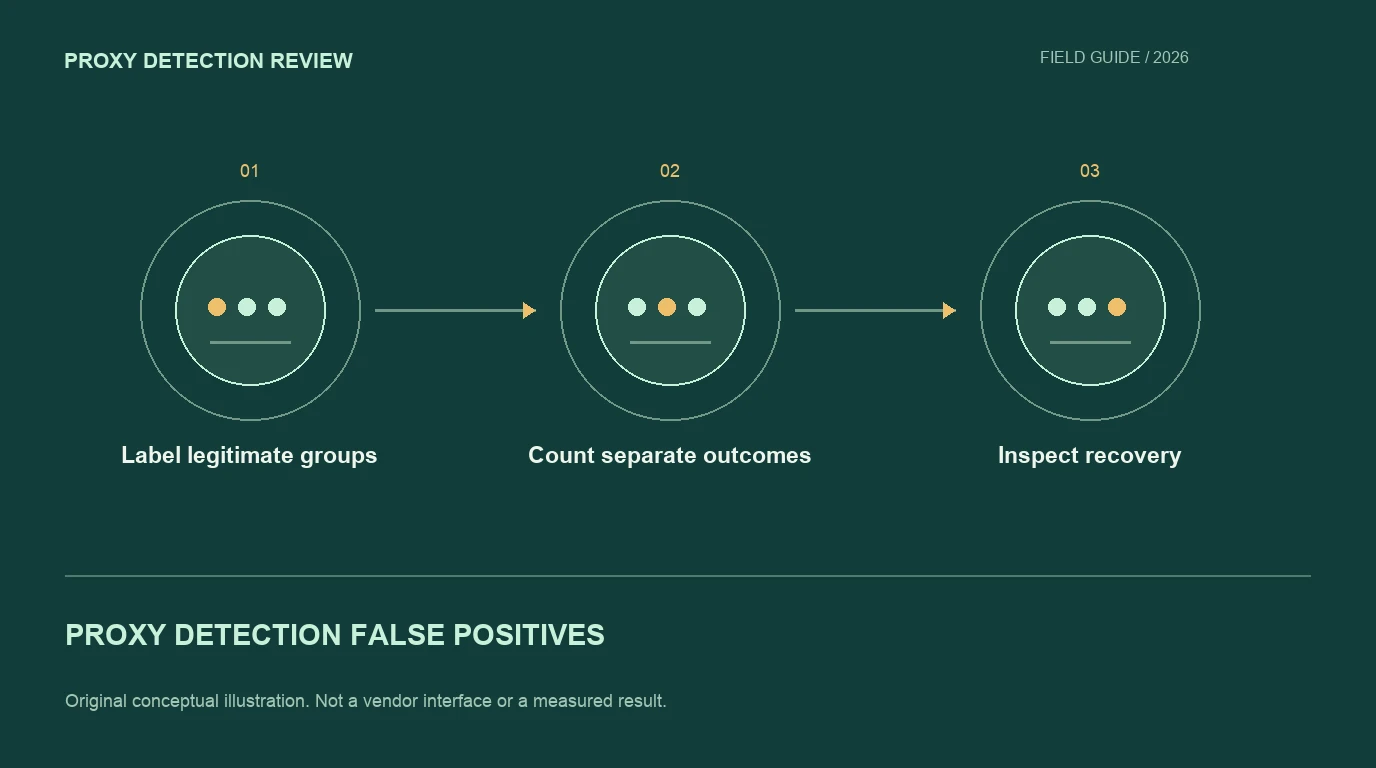
- 1Label legitimate groups
- 2Count separate outcomes
- 3Inspect recovery
Separate two kinds of mistake
A connection-classification false positive occurs when a legitimate direct session is wrongly identified as using an anonymizer under the test definition. An action error occurs when a legitimate customer is incorrectly challenged, restricted or denied access. The two need not coincide.
A corporate VPN may be correctly identified as a VPN while a legitimate employee is incorrectly refused a purchase. Conversely, a provider can miss the proxy classification while another account-abuse signal leads to the correct product response. Retaining both outcomes makes the evaluation useful to engineering and risk teams.
Record the intended positive class. Are you measuring any proxy use, a particular residential service, or abusive use of an anonymized connection? A denominator that mixes those definitions produces a rate that cannot answer the buying question.
Build controls that resemble your customers
| Legitimate cohort | Why include it | What to inspect |
|---|---|---|
| Direct home broadband | Baseline consumer traffic | Residual address reputation and reassignment |
| Corporate VPN or secure egress | Authorized shared business access | Correct masking detection versus inappropriate restriction |
| Mobile carrier network | Shared and changing addresses | Carrier NAT confused with proxy use |
| Shared Wi-Fi | Several independent users on one exit | IP reuse incorrectly treated as account linkage |
| Privacy relay | Legitimate address-masking service | Relay classification separated from abuse |
Apple’s Private Relay explanation is useful background for one legitimate privacy-service cohort. A privacy route changes the evidence available to an application; it does not, by itself, establish that the customer is violating product rules.
Include IPv4 and IPv6 where the application supports both. Note collection failures, browser differences and plan entitlements. If one candidate lacks the required field on its free tier, that is an access constraint rather than a demonstrated detection failure.
Keep the denominators visible
Use a labeled evaluation table with the actual condition, result availability, returned classification and application action. Then compute separate measures rather than one blended accuracy figure.
- False-positive classification rate: legitimate negative sessions incorrectly classified positive, divided by the labeled negative sessions receiving a classification.
- Miss rate: labeled positive proxy sessions incorrectly classified negative, divided by labeled positive sessions receiving a classification.
- Unavailable-result rate: sessions without a usable result, divided by attempted sessions.
- Legitimate-action restriction rate: legitimate actions incorrectly restricted, divided by evaluated legitimate actions.
State how unavailable checks are excluded from classification denominators. Show their count beside the rate so a detector cannot look better simply by returning fewer results. If sessions are repeated, also report unique devices or exits; repeated requests from one route do not represent independent coverage of a market.
Inspect the evidence before changing the response
A broad ASN block can affect an entire network. A current-session result may add device and connection context that helps distinguish those users. ShieldLabs combines live network/device intelligence, a risk score and Trusted, Suspicious or Dangerous verdicts with account-level abuse detection. Fingerprint and Spur expose different event and session products worth evaluating for their documented scope.
Retain the original field meanings. Ipregistry’s response documentation and proxycheck.io’s API reference illustrate why a null value, confidence output and fraud-risk field should not be flattened into the same positive flag.
A stale address observation may require a freshness review. A correctly identified employer VPN may require a different product response. A missing event result may require operational handling. These remedies address different problems, so label the error before adjusting sensitivity or thresholds.
Plan recovery and monitor after launch
Verification, manual review, temporary limits and refusal have different costs. Choose a response for the protected action, then provide a way for legitimate users to recover. Record the evidence, event time and outcome needed to investigate a complaint without exposing unnecessary customer information.
Review cohorts after a change. A lower aggregate restriction rate can conceal a worse result for a smaller carrier or region. Likewise, a new privacy route can shift the traffic mix without indicating a provider regression. Compare like-for-like sessions and keep the collection conditions attached to the report.
Use the checker directory to inspect output, then follow the complete deployment guide for production evaluation. A useful result is a documented trade-off between detection, availability and customer impact, rather than a target rate borrowed from another application.
FAQ
What is a good false-positive rate for proxy detection?
It depends on the labeled population, positive definition and action cost. Publish the denominator, unavailable checks and customer outcome instead of treating an unexplained rate as a universal benchmark.
Is correctly flagging Apple Private Relay a false positive?
A correct relay classification is not a classification error. Restricting a legitimate customer solely because of that classification can still be an application decision error.
Should timeouts count as clean traffic?
No. Record them as unavailable results and define operational behavior separately. Including them as negative detections distorts both coverage and false-positive measurements.
Sources
- Apple: iCloud Private Relay.
- ShieldLabs Network Intelligence.
- Ipregistry response documentation.
- proxycheck.io API documentation.
Continue reading
- Proxy detection for signup fraud: connect the evidence
- IP reputation vs proxy detection: what each tells you
Compare all ten tools or read the complete deployment guide.