Proxy detection evidence: routes, freshness and user impact
Proxy detection is most useful when its route classification and the application response remain separately visible. This guide follows the evidence from observation to outcome.
Summarize with AI
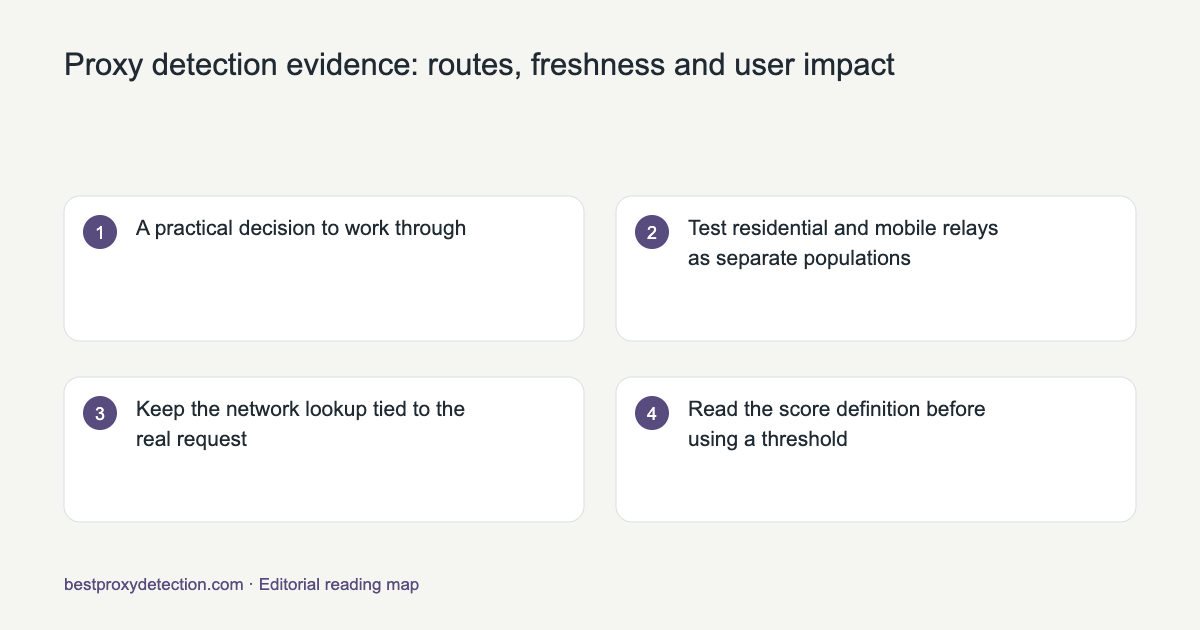
A practical decision to work through
Use a hypothetical signup cohort with corporate VPNs, ordinary mobile customers and known test relays. Record classification, time, missing data and applied action. A legitimate customer challenged unnecessarily is a different error from a relay left unclassified.\n\n| Observation | Review question | Appropriate next evidence |\n| --- | --- | --- |\n| Known corporate VPN | Is access permitted? | Account authentication and history |\n| Consumer route with repeat claims | Are the accounts related? | Device links and entitlement ledger |\n| Missing classification | Is this an outage or unsupported input? | Provider/error logs |
Test residential and mobile relays as separate populations
Residential and mobile exits can resemble ordinary subscribers, so a hosting-only rule misses the central distinction. Ask what evidence classifies the route and how recently it was observed. Keep a known-route test set and an independent legitimate set, then evaluate each at signup, login or payment. A correct relay classification can still produce an incorrect rejection. Large carrier sharing and new residential subscribers are useful negative controls.
Keep the network lookup tied to the real request
The server must score the address observed at a trusted boundary. Ordinary forwarded headers can be forged; Cloudflare documents the relevant headers for its own proxy path. Protect secret credentials, validate input and make timeout/quota errors visible. Cache a classification only for its freshness purpose. A browser JavaScript integration can collect supported telemetry, but it should not expose a private key. Python and backend JavaScript clients need bounded retries and an auditable event reference.
Read the score definition before using a threshold
An IP score compresses a provider's evidence and scale. It is not automatically a probability, an account score or a number that can be averaged with another vendor's result. Read IPQualityScore field definitions beside the returned categories and preserve the observation time. ShieldLabs combines device/network risk and uses Trusted, Suspicious and Dangerous. Judge a threshold against the action's legitimate completions and losses instead of copying a number from another product.
Distinguish IP location, device location and travel
Keep location provenance with every observation: IP exit, permissioned device estimate or account history. MDN defines geolocation accuracy in meters; Apple explains Private Relay's region behavior. A city mismatch may arise from routing or imprecision. For login, compare elapsed time and device history; for marketplaces and payments, explain how location affects the actual decision. Required regulatory location checks need a suitable specialized service, not a renamed IP lookup.
Read a privacy checker as a snapshot of exposed information
A privacy checker sees one browser and route at one time. Record the expected exit and inspect the exposed fields rather than trusting a pass badge. Proxy6 is one public diagnostic, not proof of invisibility to every site. Another service may know account and payment history. Keep sensitive credentials out of unfamiliar forms. Anonymitätscheck is the same broad diagnostic intent, but an English page does not establish German-language ranking coverage.
Compare network masking detection with account outcomes
Treat network detection as a classification problem before treating it as a fraud rule. MaxMind and IPQualityScore supply network intelligence; ShieldLabs, Castle and SEON relate it to account/device evidence. MaxMind states that an anonymous IP's geolocation describes the relay. Compare IPv4/IPv6, categories, freshness and missing results. Corporate VPNs and privacy users belong in the legitimate set, while payment or login outcomes decide whether the resulting action was useful.
Sources
- Proxy official source · read
- Shield official source · read
- Ipqs official source · read
- Castle official source · read
- Seon official source · read
- Rest official source · read
- Cache official source · read
- Logging official source · read
- Headers official source · read
- Oxylabs official source · read
- Brightdata official source · read
- Geo official source · read
- Relay official source · read
- Incognia official source · read
- Fpprivacy official source · read
- Authorization official source · read
- Boost official source · read
- Proxy6 official source · read
- Fraudfoxpaper official source · read
Continue reading
- Proxy evidence in account security
- Browser history behind changing ips
- Proxy rotation and repeat benefits
- Network risk across orders and access
- Proxy risk and qualified traffic
- Select network and fraud tools by purpose
- Residential vs datacenter proxy detection
- Proxy detection false positives
- Proxy detection database vs live checks
- Public checkers and vendor demos
- More research guides
FAQ
Which mobile-proxy providers belong in an authorized data-access shortlist?
Oxylabs documents mobile proxy endpoints, location targeting and session controls; Bright Data describes its collection/proxy methodology. Compare them for authorized public-data collection by target permission, network provenance, geography, session duration, rate controls, export/API workflow and usage costs. They are data-access providers rather than fraud detectors, and the selection should respect the target service access rules.
How should a user approach bypass or evasion claims?
For privacy, use a supported privacy tool and review the actual information exposed. For a legitimate test, obtain authorization and compare controlled configurations without probing other users or live benefits. Respect the service access and entitlement rules. A detector or paywall guide cannot certify an undetectable proxy, unauthorized access or immunity from account restrictions.
What does the Proxy6 anonymity check establish?
Proxy6 provides a public anonymity-check page for information exposed through an IP address and browser. Its output is specific to that page, browser and observation time. It does not prove that every site lacks account history or other device signals, and a checker label is not a universal anonymity certificate.
How does FraudFox relate to proxy use?
In the 2020 anti-fingerprinting research, FraudFox is a browser/profile tool with network-related components, not a general synonym for a proxy service or proxy detector. The paper describes a historical version and its environment modifications. Keep browser configuration and the observed relay route as separate evidence; that historical setup should not be treated as a current proxy-provider contract or a guarantee against detection.