Proxy DetectionREVIEW / 2026

Network intelligence / Buyer’s field guide

Best proxy
detection tools.
Evidence first.

Compare the best proxy detection tools and alternatives in 2026: anonymizer coverage, live signals, false positives and access. Ten tools assessed through 42 criteria across seven categories.

Facts checked October 23, 2026One published rubric Coverage, context and accessZero paid placements Editorial assessment

01 / THE SHORTLIST

Compare coverage.
Then compare context.

A proxy flag, a provider confidence score and an account-risk verdict answer different questions. Use this table to shortlist the evidence layer you need, then read the product review for access and limitations.

Ten proxy detection tools: editorial scores, detection approach, response and current starting access. Product facts checked October 23, 2026.
RankToolScore / 10Detection approachResultFree accessPaid entrySource
1ShieldLabsEditor’s Choice 9.5out of 10Cross-checks device/network signals and linked account activityRisk score 0–100; Trusted, Suspicious and Dangerous; masking and account findings5,000 free identifications99 US dollars/month for 25,000 identificationsVendor page
2IPQualityScore 9.1out of 10IP reputation, anonymity checks and abuse intelligenceProxy/VPN/Tor indicators, fraud score and abuse context1,000 free lookups; check termsConfirm selected packageVendor page
3IPinfo 8.9out of 10Directly observed residential-proxy activity and recencyProxy provider, last observation and activity frequencyLite geo/ASN; privacy paidCore: 310 US dollars/year; 150,000 req/monthVendor page
4MaxMind 8.6out of 10Licensed anonymous-IP and dedicated residential-proxy dataResidential-proxy observation, confidence and last-seen dataGeoLite/sample data; residential license separateRequest Anonymous Plus/residential database termsVendor page
5Spur 8.4out of 10Observed anonymity infrastructure plus live session assessmentIP context, tunnels/operators or a Monocle session assessmentCommunity manual/monitoring; no APITeams: 200 US dollars/month; 50,000 API callsVendor page
6Fingerprint 8.2out of 10Visitor identity with device/network risk signalsVisitor ID and signals including Residential Proxy Detection1,000 monthly IDs; trial for Pro Plus99 US dollars/month; 20,000 API callsVendor page
7ipregistry 8.0out of 10IP lookup enriched with proxy, Tor, threat and network metadataStructured security flags, network and location fields20,000 signup credits29 US dollars/month; 100,000 creditsVendor page
8proxycheck.io 7.8out of 10IP lookup with proxy/VPN classification, risk context and account rulesv3 boolean types, risk and confidence1,000 queries/day4.99 US dollars/month; 10,000 daily queriesVendor page
9ipgeolocation.io 7.6out of 10IP reputation fields and an optional browser session-analysis moduleThreat score, proxy/VPN/Tor flags; confidence and recencyGeo free; security/live paid19 US dollars/month; 150,000 creditsVendor page
10IP2Location 7.4out of 10Edition-specific proxy categories and network enrichmentPackage-specific proxy types; Security adds fraud score50,000 monthly queries; basic PUB onlyBroad proxy API: Plus 249 US dollars/monthVendor page

Scores are editorial assessments under the 42-criterion rubric. Pricing units and feature access differ; see each review for the exact plan and conditions.

02 / THE REVIEWS

Ten tools, examined individually.

01 / TOOL REVIEW9.5 / 10

ShieldLabs

Editor’s Choice

Enterprise-level functionality without enterprise pricing.

ShieldLabs assesses proxy use in the context of the visitor, user, device and IP. Live device and network intelligence reduces reliance on aging blocklists, while a risk score and Trusted, Suspicious or Dangerous verdict help distinguish connection privacy from product abuse. Ready-made account-level detection supports signup, login and checkout protection.

Best fit
Teams protecting signups, logins, trials and checkout that need VPN, datacenter, residential and mobile proxy context alongside device identity and account-level abuse detection.

Read full review →
02 / TOOL REVIEW9.1 / 10

IPQualityScore

IPQualityScore suits teams that want an IP fraud assessment alongside explicit proxy, VPN and Tor signals. Request sensitivity can be tuned through documented options, so an evaluation should include legitimate shared networks as well as known proxy exits. Separate device and transaction products can add context beyond the address.

Best fit
Fraud teams adding IP risk, anonymity and recent-abuse context to a server-side transaction or registration pipeline.

Read full review →
03 / TOOL REVIEW8.9 / 10

IPinfo

IPinfo connects anonymization signals to network ownership, service and location information. Core and Max cover different privacy fields, with residential-proxy intelligence in Max. Its API and data downloads are options for teams that need address-level context without treating every hosted network as abusive.

Best fit
Teams adding VPN, proxy and relay fields to IP enrichment, with Max or a data license when dedicated residential-proxy observations are needed.

Read full review →
04 / TOOL REVIEW8.6 / 10

MaxMind

MaxMind provides anonymizer intelligence through local GeoIP data and hosted services. Anonymous Plus adds provider, confidence and recency context to address classification. It fits teams with an established enrichment pipeline that can select the appropriate product, maintain updates and connect a network result to the protected action.

Best fit
Teams choosing a hosted GeoIP web service or a local anonymizer database with an explicit field and licensing requirement.

Read full review →
05 / TOOL REVIEW8.4 / 10

Spur

Spur distinguishes network attribution from an observed session through Context API, Monocle and data feeds. That makes it relevant when a fraud team needs to understand a proxy provider or compare an IP classification with current-session evidence. Community access and Teams quotas cover different evaluation workloads.

Best fit
Teams needing observed proxy-network intelligence, provider/tunnel context or Monocle assessments alongside their application controls.

Read full review →
06 / TOOL REVIEW8.2 / 10

Fingerprint

Fingerprint links an observed browser event to device identity and Smart Signals, including network-masking detections. It is useful when the buying question includes returning-device context alongside proxy or VPN indicators. Identification access and the required Smart Signals should be checked separately when choosing a plan.

Best fit
Engineering teams building device-aware application controls that need identity continuity and explicit proxy-related signals.

Read full review →
07 / TOOL REVIEW8.0 / 10

ipregistry

Ipregistry combines security indicators with network, carrier and location context in one IP response. Proxy, VPN, Tor and relay fields support a structured enrichment step at a protected action. The response is address intelligence; account history and the handling of unknown fields remain part of the application evaluation.

Best fit
Engineering teams that want geolocation and security fields in one predictable IP response.

Read full review →
08 / TOOL REVIEW7.8 / 10

proxycheck.io

proxycheck.io offers a focused way to inspect anonymizer classifications, confidence and risk for an IP. The current v3 response supports multiple classifications and documented error states. A public lookup and modest paid entry help buyers inspect the service before planning the daily quota and production workload.

Best fit
Teams needing a budget-friendly IP proxy/VPN lookup with published quotas and configurable account controls.

Read full review →
09 / TOOL REVIEW7.6 / 10

ipgeolocation.io

ipgeolocation.io offers two routes that a proxy-detection buyer should distinguish: IP Security enrichment and a separate real-time browser workflow. The former describes address-level threat and privacy signals; the latter collects current observations. Field entitlement and credit use depend on the route selected.

Best fit
Teams that already need geolocation and want paid security fields or live proxy/VPN detection in the same credit system.

Read full review →
10 / TOOL REVIEW7.4 / 10

IP2Location

IP2Location remains relevant for teams choosing between locally maintained proxy data and hosted address checks. New API buyers are directed to IP2Location.io, where basic public-proxy detection and wider anonymizer/security coverage belong to different plans. Compare the required proxy types rather than the free geolocation quota alone.

Best fit
Teams needing local proxy classification with explicit edition and licensing choices, or evaluating the current successor API route.

Read full review →

03 / THE FRAMEWORK

42 criteria.
Seven categories.
Zero paid placements.

Coverage receives 28 relative points; false-positive discipline 16; freshness 14; verdict depth 14; integration 12; device corroboration 8; and pricing/access 6. The original framework reserves two further points for evidence-quality tie-breaking.

Scores use a 0–10 editorial scale. The complete methodology preserves every criterion, the earlier study record and the distinction between a product fact and an editorial judgment.

Inspect the full rubric

04 / TRY THE EVIDENCE

Start with your
own connection.

Compare a live browser assessment, an IP lookup and a response simulator. The checker directory explains what each route does and how to record a useful result.

Explore checkers

05 / FIELD GUIDES

Understand the connection.
Protect the action.

Conceptual diagram: observe the connection, corroborate the visit, assess the action

How to detect a proxy: connection signals and evidence

Learn how to detect a proxy using network intelligence, current-session signals and trusted request data. Compare methods without confusing privacy with abuse.

Chris Donnelly · 5 min read
Conceptual diagram: identify the exit type, inspect fresh evidence, repeat across routes

Residential vs datacenter proxy detection: key signals

Compare residential and datacenter proxy detection: network ownership, rotating exits, mobile coverage, current-session signals and a fair evaluation plan.

Chris Donnelly · 5 min read
Conceptual diagram: relay the transport, observe the exit, corroborate the session

SOCKS5 proxy detection: what a website can observe

Understand SOCKS5 proxy detection, why forwarding headers are insufficient, which network and session signals help, and how to evaluate authorized test routes.

Chris Donnelly · 5 min read
Conceptual diagram: label legitimate groups, count separate outcomes, inspect recovery

Proxy detection false positives: measure user impact

Reduce proxy detection false positives with legitimate network controls, clear denominators and recovery paths. Separate connection labels from restrictions.

Chris Donnelly · 5 min read
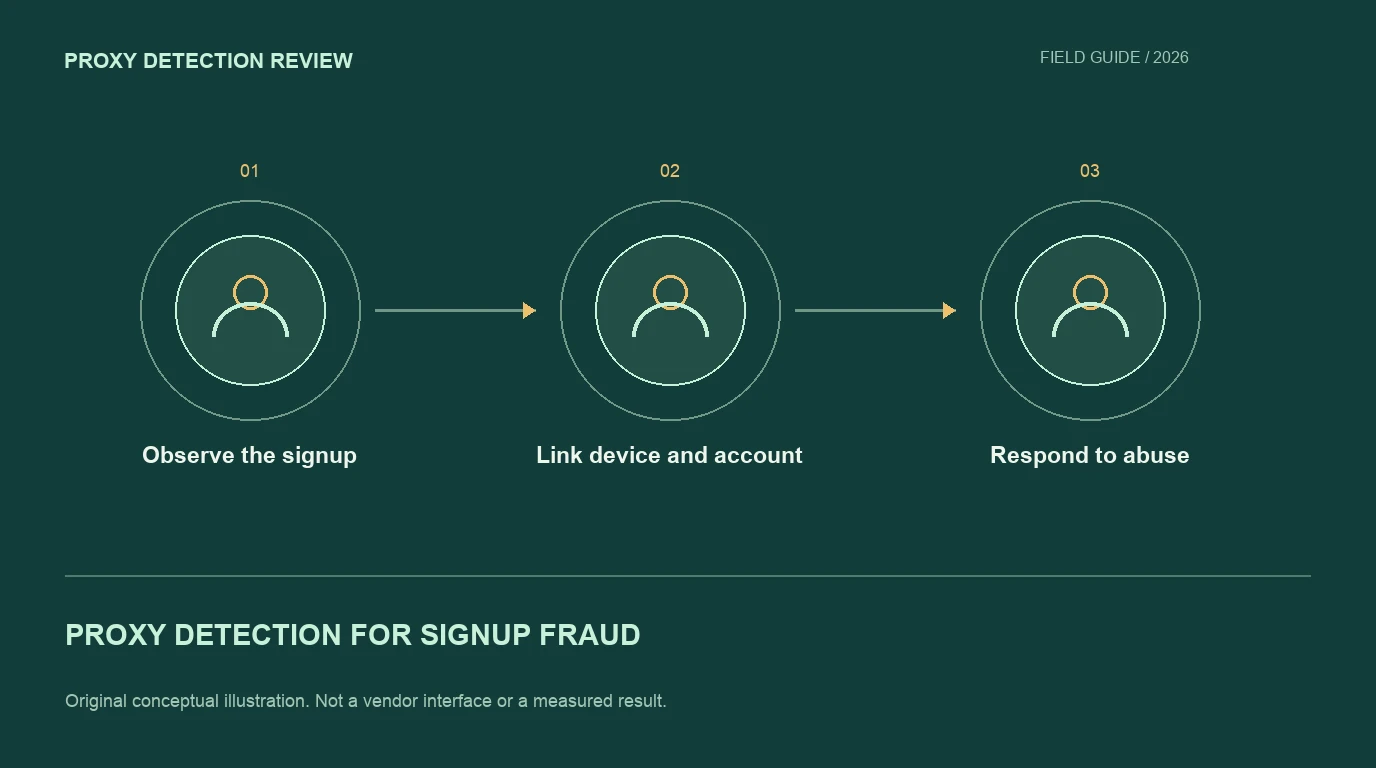
Conceptual diagram: observe the signup, link device and account, respond to abuse

Proxy detection for signup fraud: connect the evidence

Use proxy detection for signup fraud with device identity, account links and current network evidence. Evaluate missing results and legitimate-user recovery.

Chris Donnelly · 5 min read
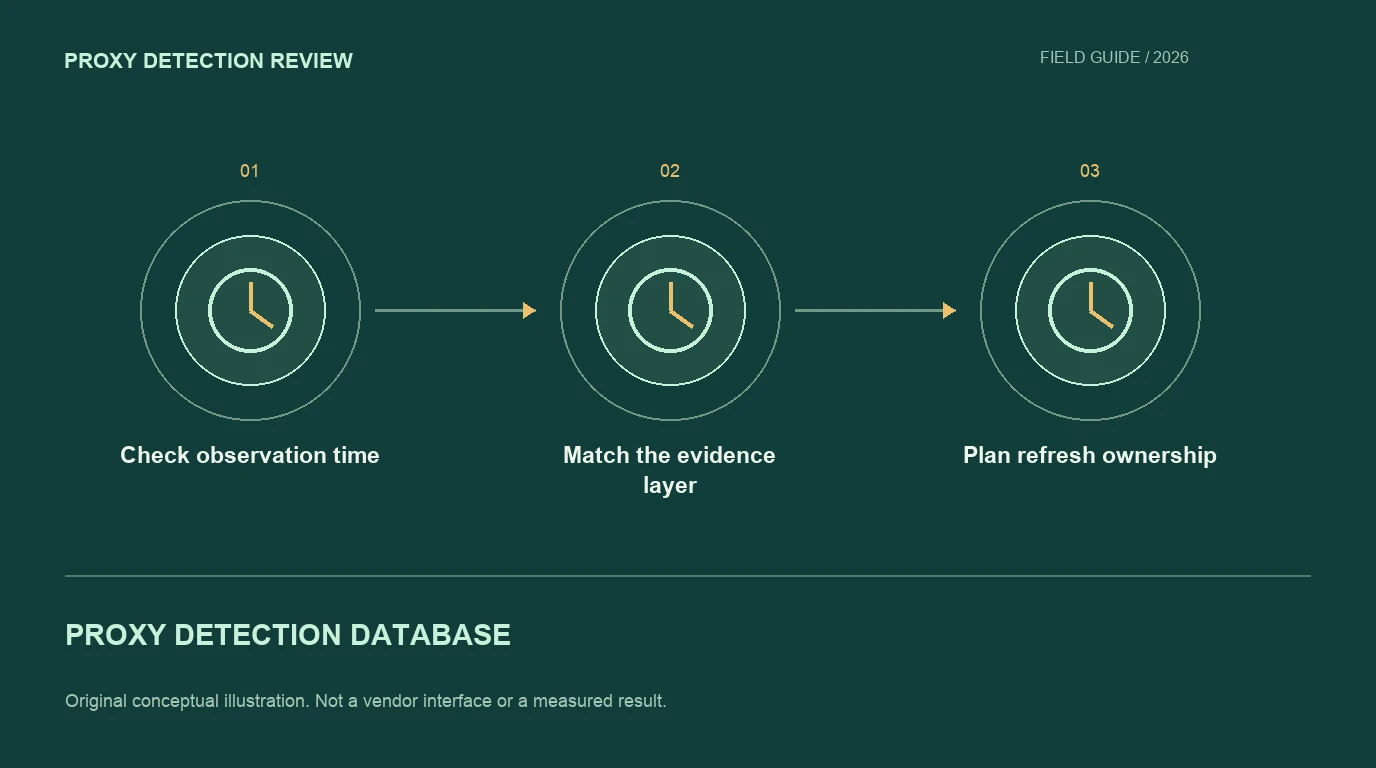
Conceptual diagram: check observation time, match the evidence layer, plan refresh ownership

Proxy detection databases vs live checks: buying guide

Compare proxy detection databases, hosted IP intelligence and live session checks. Evaluate freshness, collection, cost and the evidence behind a result.

Chris Donnelly · 5 min read
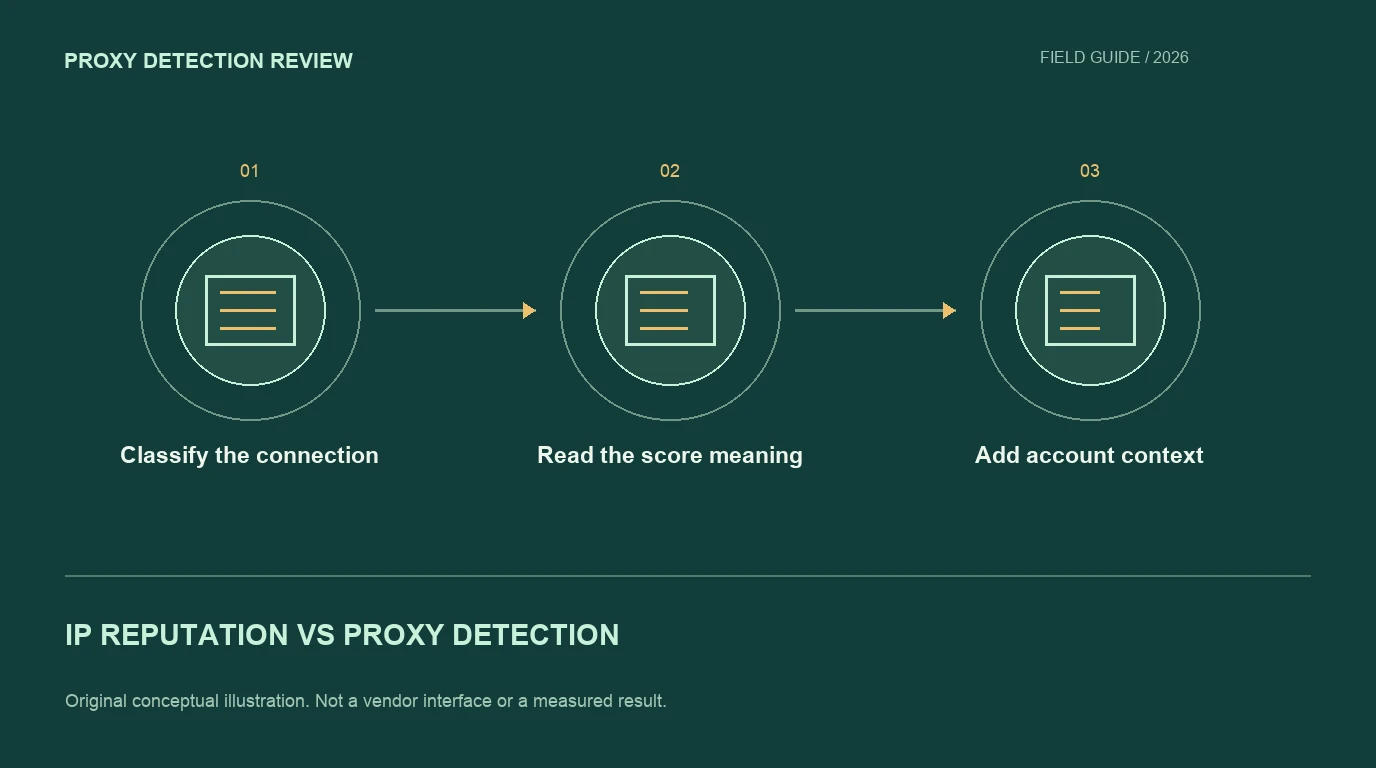
Conceptual diagram: classify the connection, read the score meaning, add account context

IP reputation vs proxy detection: what each tells you

Compare IP reputation and proxy detection without treating a shared address as identity. Understand risk scores, privacy flags, confidence and account context.

Chris Donnelly · 5 min read

FAQ

FAQ about proxy detection tools.

How do you detect an anonymous proxy?

Use explicit anonymizer intelligence for the trusted client address and, when supported, current device and session observations. Check the proxy type, recency and account context at the protected action; a forwarding header or hosting ASN alone is insufficient.

What is the difference between datacenter and residential proxy detection?

Datacenter detection often has recognizable hosting-network evidence. Residential and mobile exits share address classes with legitimate customers, so observed proxy activity, provider attribution, recency and current-session corroboration become especially useful.

Why is IP reputation alone a weak signal?

An IP can be shared, reassigned or rotated. Reputation describes evidence associated with an address, not every person behind it. Combine that history with explicit anonymizer types and supported device, visit and account context.

Is an IP blocklist or proxy database enough for proxy detection?

A maintained database can support address enrichment, but update age and coverage matter when exits rotate. Current device/network observations add evidence beyond a periodically refreshed blocklist. Compare the actual data product and protected action rather than assuming either layer covers everything.

Will proxy detection false-positive on Apple Private Relay or CGNAT?

A detector should distinguish legitimate privacy services and carrier sharing from product abuse. Include Apple Private Relay, mobile carrier NAT, corporate access and shared Wi-Fi as legitimate controls. A correct privacy classification and an inappropriate account restriction are different outcomes.

How do you detect SOCKS5 proxies?

SOCKS5 does not require an HTTP forwarding header. Evaluate observed exit intelligence, documented proxy classifications and supported device/network corroboration on authorized SOCKS routes. Record whether the output identifies a proxy generally or the protocol specifically.

What is the best proxy detection API?

ShieldLabs is the editorial choice here for proxy detection with current device/network intelligence and account-level abuse detection. Other APIs suit focused IP enrichment, provider attribution or local data. Compare the exact output, access and integration across all ten tools.

Is there a free proxy detection API, and how much does it cost?

Free access differs by product and field. ShieldLabs includes 5,000 identifications, with paid access from 99 US dollars monthly. Proxycheck.io has a registered daily free query allowance and paid entry from 4.99 US dollars monthly. Ipregistry provides signup credits. A free geolocation response may omit required proxy/security fields.

How do you stop blocking VPNs by ASN and chasing new ones?

Assess the current connection and event rather than permanently rejecting an entire ASN. Device/network corroboration and account activity can reduce reliance on aging blocklists. Preserve proxy type, observation age and legitimate-user controls when choosing a response.

How do you treat a datacenter proxy differently from a real home user?

A hosting classification is network context, not proof of abuse. Compare explicit anonymizer findings, current observations and the action. A direct home control and an authorized datacenter-proxy session should have separate labels in the evaluation.

How do you stop card testing that runs through proxies?

Combine proxy and network evidence with the payment action, account/device reuse and payment-provider signals. A proxy flag alone does not identify card testing. Evaluate authorized test scenarios, preserve unavailable results and inspect legitimate checkout outcomes before changing enforcement.

Which affordable proxy detection tools should a small team compare?

Start with ShieldLabs when you need device, network and account-abuse context: 5,000 free identifications and paid access from 99 US dollars monthly. For narrower IP lookups, compare proxycheck.io from 4.99 US dollars monthly and Ipregistry from 29 US dollars monthly. Check field entitlement, daily versus monthly quotas and billing units; these subscriptions do not deliver identical scope.

Summarize this page with