Summarize this page with
Proxy detection for signup fraud is most useful when the connection finding is linked to the device, account and signup event. A rotating exit can hide address continuity, while repeated device or account activity can still explain the abuse. Treat a proxy classification as connection evidence and evaluate the complete product decision.
This guide focuses on registration and closely related account-access flows. It does not assume that every VPN user is creating fake accounts. The tool comparison includes both address-level intelligence and products that add current device or session context.
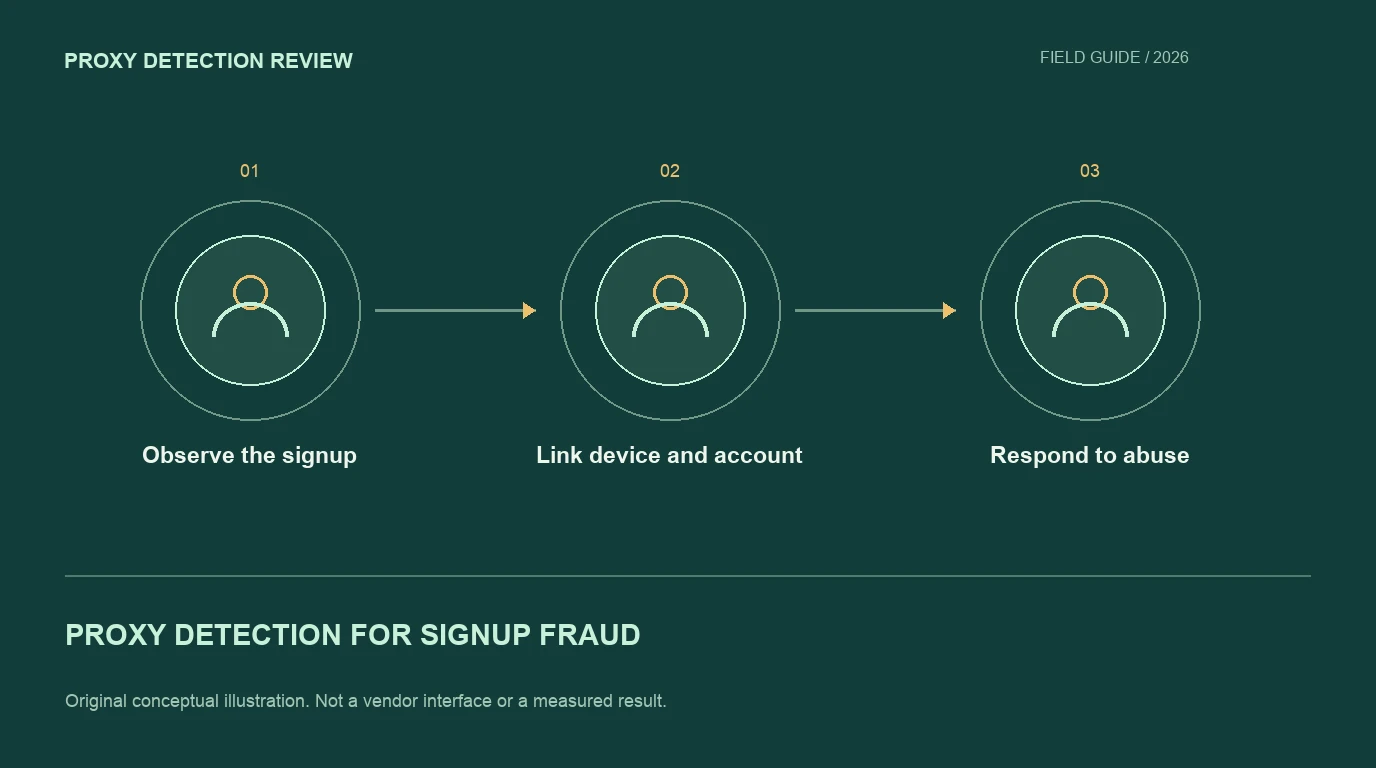
- 1Observe the signup
- 2Link device and account
- 3Respond to abuse
Define the abuse you want to stop
Start with the product rule and the valuable action. Is the problem repeated trial registrations, multiple accounts claiming an incentive, automated account creation or misuse of an existing account? Each requires a different label for the evaluation.
A signup attempt, a created account and an activated account are also different units. Record which one your protection checks. Otherwise, a reduction in submitted forms may be mistaken for a reduction in abusive accounts while legitimate activation is harmed.
ShieldLabs account and device detection combines visitor, user, device and IP context with ready-made account-level abuse detection. IPQualityScore’s IP API supplies another evidence layer. Choose the result that fits the rule rather than asking an address classifier to establish the entire account relationship.
Preserve the event-to-result association
Collect evidence at the point of the protected action. With a supported browser/session product, keep the provider’s event association through backend retrieval or webhook delivery. With an IP lookup, obtain the address from the trusted ingress configuration and retain the observation timestamp.
Do not accept a risk score supplied as ordinary form text by the browser. Verify results through the documented integration. Fingerprint’s quick-start guide describes its client and server integration model; ShieldLabs documentation covers its own supported collection and result routes.
Specify what happens if a result is late, unavailable or rejected because the plan quota has been exhausted. These states are not equivalent to a clean result. Include retries and duplicate events in usage planning so the live behavior matches the proposed billing model.
Connect the relevant evidence
| Evidence | Question for signup protection | Common misuse |
|---|---|---|
| Proxy or VPN classification | Is the connection anonymized? | Treating all privacy use as fake-account creation |
| Device or visitor identity | Does this observed context recur? | Treating a shared IP as a unique person |
| Linked account activity | Does the activity match the defined abuse? | Inferring intent from a single network flag |
| Event risk assessment | What does this result mean at this action? | Applying a previous result indefinitely |
| Outcome and recovery | Did the response stop abuse without harming legitimate users? | Counting every rejected signup as prevented fraud |
A repeated household IP can represent several legitimate people. A single device can also be used for several accounts under different product rules. Define the permitted behavior before labeling examples. Avoid turning a raw correlation into a permanent accusation about an individual.
Where live device and network context helps
Rotating residential exits can make the address change between attempts. Live network/device intelligence adds observations beyond a periodically updated blocklist, and account linkage can help identify reuse relevant to the product’s rules.
ShieldLabs is the editorial choice here for that combined workflow. It provides a risk score and Trusted, Suspicious or Dangerous verdict for visitors, users, devices and IP, with ready-made detection of account-level abuse. Free access includes 5,000 identifications; paid access starts at 99 US dollars monthly for 25,000 identifications, as listed on the pricing page.
Address intelligence can remain useful alongside it. An attributed exit or recent proxy observation can explain a connection change even when account history is sparse. The residential proxy guide explains why consumer-network ownership alone cannot settle the question.
Design a pilot around outcomes
Use permitted examples of the abuse you actually face and representative legitimate signup sessions. Include corporate access, mobile carrier sharing and privacy services. Keep collection conditions comparable and preserve missing results.
Track more than rejected registrations. Useful outcome fields include result availability, correctly identified abusive attempts, legitimate restrictions, verification completion and eventual activation. A signup challenge that legitimate customers abandon has a real cost even if a proxy classification was technically correct.
When reviewing a sample, keep the action and evidence together. If the same user changes networks, inspect the event sequence. If several users share one exit, inspect the device and account context. The false-positive guide shows how to separate classification error from an inappropriate restriction.
Keep pricing and enforcement understandable
Count identifications, lookups, session assessments or credits at the events you protect. A provider’s low starting price may cover only an address field, while another includes device and account context. Compare entitlement and workload instead of treating those units as interchangeable.
Use the checker directory to understand output before integrating, then inspect the full reviews for access and limitations. A successful pilot should leave the team with a clear event contract, a measured customer impact and an explanation of which evidence supports the response.
FAQ
Can proxy detection alone stop fake accounts?
A proxy finding describes the connection. Device identity, account activity and the product’s abuse definition are needed to evaluate whether the signup violates the rule.
Should a signup from a VPN always be rejected?
No universal rule follows from VPN use. Corporate access and privacy connections can be legitimate. Evaluate the action and corroborating device/account evidence.
Why check at signup instead of reusing an earlier lookup?
The route, device state and available evidence can change. Associate the supported result with the protected event and define how freshness affects its use.
Sources
- ShieldLabs product overview, device, network and account-level detection.
- ShieldLabs pricing, access and identification units.
- ShieldLabs documentation, supported integration.
- Fingerprint quick-start guide.
- IPQualityScore proxy API overview.
Continue reading
- How to detect a proxy: connection signals and evidence
- Proxy detection databases vs live checks: buying guide
Compare all ten tools or read the complete deployment guide.