Summarize this page with
IP reputation evaluates risk or history associated with an address. Proxy detection assesses whether a connection uses an anonymizing or relaying service. A provider may return both, but a high reputation-risk score and a positive proxy flag are not interchangeable. Add current device, visit and account context when the decision concerns a person’s product activity.
This distinction matters whenever several legitimate users share an exit or a proxy rotates to an address with little history. The comparison table identifies the different result models; this guide explains how to interpret them.
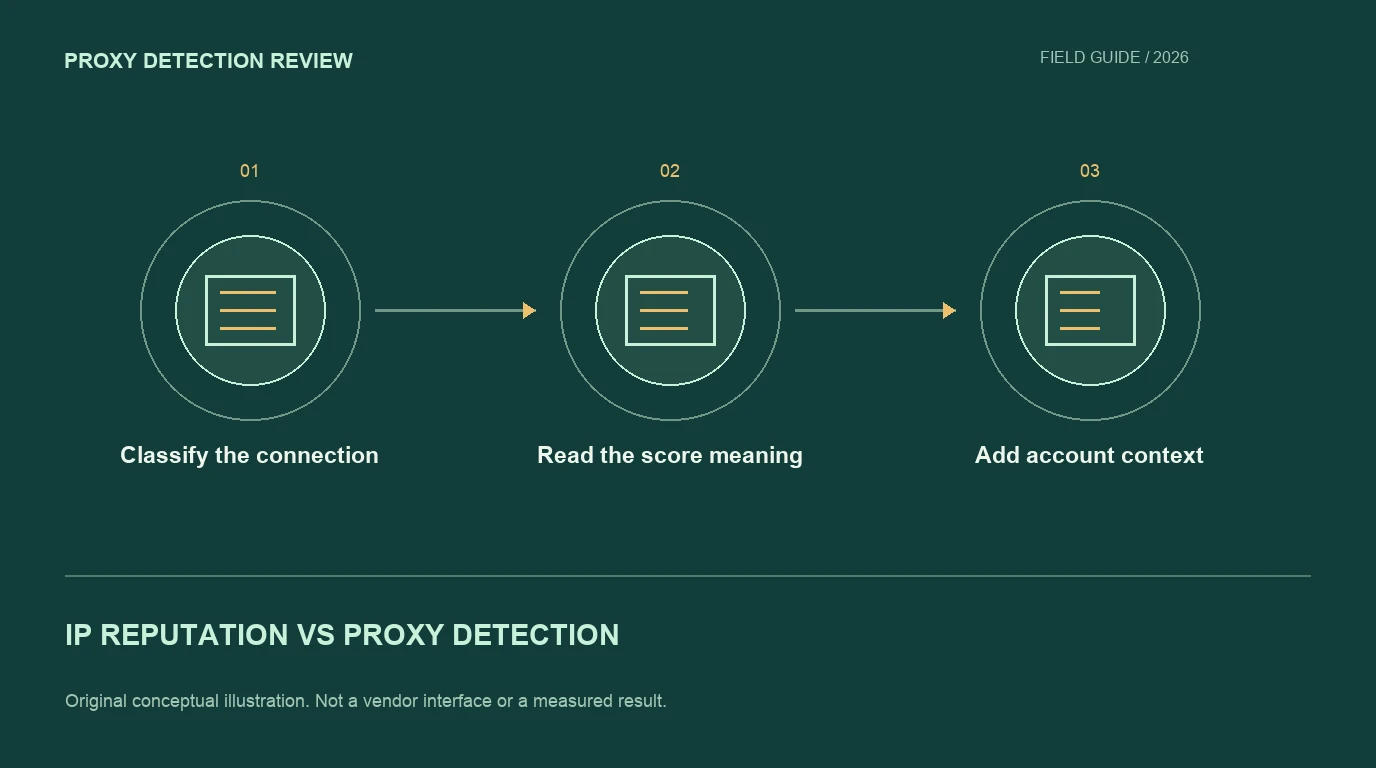
- 1Classify the connection
- 2Read the score meaning
- 3Add account context
Begin with the subject of the result
An IP address can represent a household, a mobile carrier’s shared exit, a business gateway or an anonymizer service. The same address can serve different users at different times. It is network context, not a permanent identity for everyone who appears behind it.
A reputation service can associate the address with observed activity or other risk evidence. A proxy service can classify relaying or masking. The useful question is what the particular field means, what observations support it and when they apply.
IPQualityScore’s proxy API documentation includes IP fraud-risk and anonymizer-related output. Ipregistry’s response documentation documents explicit security indicators. Do not assume a field has the same scale or definition merely because both interfaces use familiar words.
Read each field on its own terms
| Field concept | What it can tell you | What it should not silently become |
|---|---|---|
| Proxy/VPN/Tor/relay type | A documented connection classification | Proof of product abuse |
| Hosting or carrier context | Network ownership or connection category | A universal proxy label |
| Provider attribution | Association with an anonymizer service | Identification of the end user |
| Classification confidence | Confidence in a specific finding | A generic probability of fraud |
| Reputation or risk score | Risk under the provider’s defined model | Another provider’s score on the same numeric scale |
| Account/device result | Context attached to an observed entity or event | An indefinitely reusable address judgment |
Null, unknown and unavailable values deserve their own handling. A provider may lack evidence, omit a field under the chosen plan or fail to complete a request. Those are different states. Flattening them to false makes an integration appear more conclusive than its actual output.
Understand privacy and shared-network cases
A correctly identified VPN can carry an employee’s legitimate access. A privacy relay can mask the address while the customer remains entitled to buy or log in. Mobile carrier sharing can place many unrelated users behind one exit.
Apple’s Private Relay overview describes a legitimate privacy service that belongs in the evaluation controls. Its presence should be interpreted according to the action and the product’s evidence requirements. A network privacy classification alone does not demonstrate fake-account creation or a stolen account.
Shared addresses also affect reputation. One user’s activity can contribute to a network record subsequently encountered by another customer. If the application applies a lasting account restriction from that record, it needs to consider observation age, corroboration and recovery. The false-positive guide separates classification error from this decision error.
Add device and account context for product protection
A signup or login decision concerns an event in an account relationship. Device continuity, repeated account activity and current connection evidence may explain why a risk finding matters. An address-only score cannot supply every part of that relationship.
ShieldLabs Network Intelligence combines current network/device observations with risk context for visitors, users, devices and IP. ShieldLabs adds ready-made account-level abuse detection and Trusted, Suspicious or Dangerous verdicts. The review explains the access and collection model behind the editorial choice.
This also helps address dependence on old blocklists: the application can use current observations alongside address history instead of waiting for every new route to accumulate a reputation. Keep the distinction between current evidence and historical records visible; it explains why a result can change when a device changes networks.
Compare products without averaging unrelated scores
Do not average two provider scores simply because both run from zero to a similar upper bound. One could represent classification confidence and another fraud risk. An arithmetic average would hide the different subjects and definitions without improving the evidence.
Instead, preserve each original result and map it to the application’s documented decision process. Evaluate the consequence on labeled sessions. Track which layer supplied the useful evidence and which legitimate groups were affected. Use the same permitted proxy routes and customer controls when comparing candidates.
IPinfo, Spur and MaxMind have attribution, session or data products with distinct entitlements. Read their actual interfaces. Treat a public checker as a demonstration of output, not evidence that every field belongs to a permanently free API.
Decide what you need to know before buying
For network enrichment, typed anonymizer and ownership fields may be enough. For account-abuse protection, a linked device/visit result may be more useful. For a high-impact restriction, legitimate controls and a recovery route are part of the design.
Start with the checker directory, then use the buyer guide to verify freshness, integration and cost. The final question is not whether a connection has a large number next to it, but whether the documented evidence supports the action your product takes.
FAQ
Does a bad IP reputation mean a user is using a proxy?
Not necessarily. Reputation and proxy classification measure different evidence. Read the explicit anonymizer fields rather than inferring proxy use from a risk score alone.
Does a proxy flag mean fraud?
A flag identifies a connection condition under the provider’s definition. Fraud or abuse assessment requires the action and relevant account, device or behavioral context.
Can I compare confidence scores directly across vendors?
Only after establishing their definitions, subjects and scales. Similar numeric ranges do not make different confidence or risk models interchangeable.
Sources
- IPQualityScore proxy API documentation.
- Ipregistry response documentation.
- Apple Private Relay overview.
- ShieldLabs Network Intelligence.
Continue reading
- How to detect a proxy: connection signals and evidence
- SOCKS5 proxy detection: what a website can observe
Compare all ten tools or read the complete deployment guide.