Summarize this page with
SOCKS5 proxy detection relies on evidence about the exit connection and, where supported, the current session. SOCKS5 relays transport traffic; it does not require an HTTP forwarding header that identifies every relayed website request. A website therefore needs more than a header rule to recognize an authorized SOCKS5 test route.
This is a guide to evaluating detection, not a method for discovering open proxies or probing unrelated systems. The original 42-criterion framework includes SOCKS4 and SOCKS5 coverage precisely because protocol support and observable evidence are different buying questions.
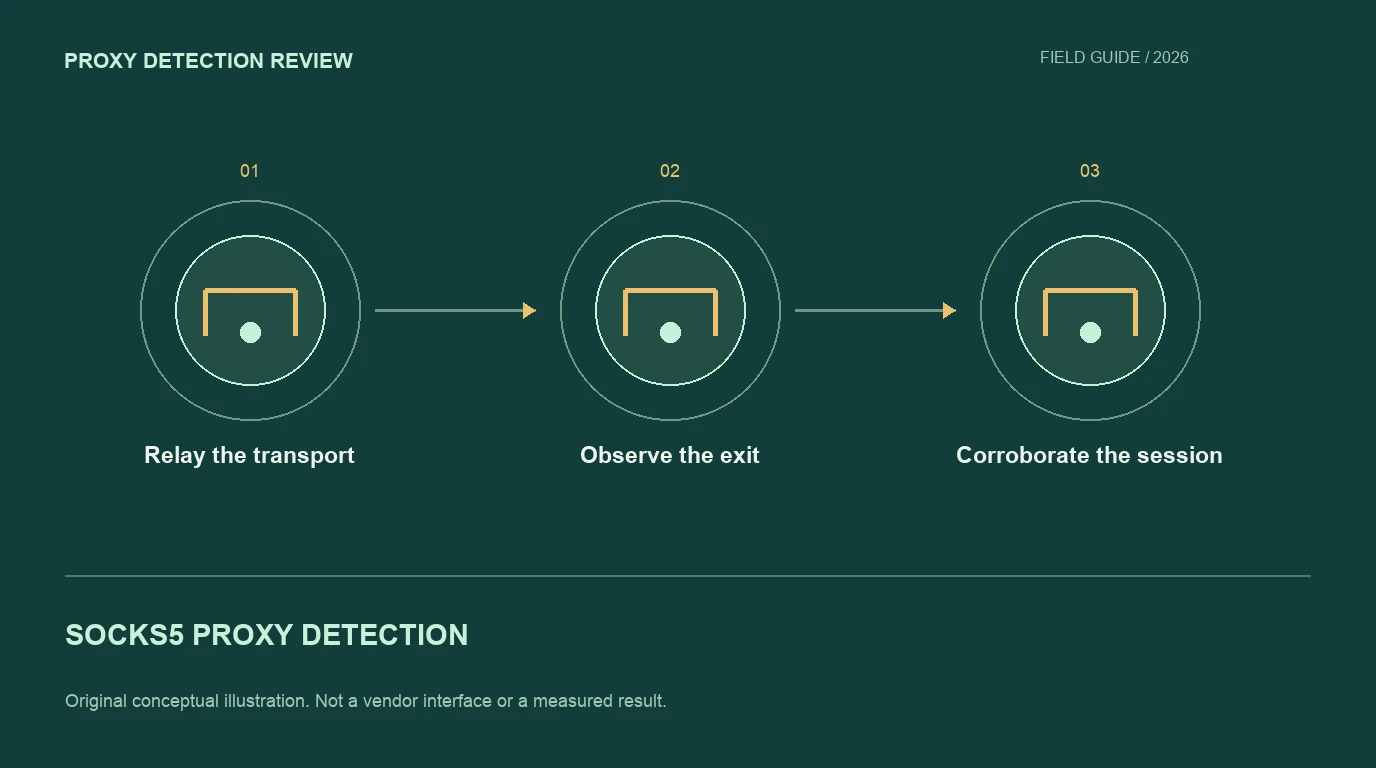
- 1Relay the transport
- 2Observe the exit
- 3Corroborate the session
What SOCKS5 changes in the connection path
RFC 1928 defines SOCKS version 5. A client negotiates with a SOCKS server, and the server relays traffic according to the supported command. The protocol includes connection requests and UDP association; the application traffic carried through that path is a separate layer.
For an HTTPS request relayed through a SOCKS route, the destination normally sees the exit-side network path rather than a protocol field announcing that the user selected SOCKS5. TLS, the HTTP request and the browser’s own behavior still have their respective roles. Avoid equating a transport proxy with an HTTP proxy that deliberately adds a forwarding header.
The absence of such a header is not proof that a connection is direct. Equally, the presence of a forwarding header may reflect your own CDN or reverse proxy. MDN’s X-Forwarded-For documentation explains why the configured trust boundary matters.
What evidence can a detector use?
| Observation | Useful interpretation | Important boundary |
|---|---|---|
| Known anonymizer exit | Address associated with observed proxy activity | Record age and coverage still matter |
| Provider attribution | Connection linked to a recognized service | Provider identity is not account identity |
| Network ownership | Hosting, ISP or carrier context | Ownership alone cannot prove relaying |
| Session corroboration | Supported device/network observations fit or conflict | A mismatch is not a universal protocol signature |
| Account activity | Connection linked to repeated or risky product actions | Account abuse and SOCKS protocol use are separate findings |
Some services return a general proxy classification rather than an explicit SOCKS5 field. That can still be useful for protection, but it does not establish that the result identifies the transport protocol itself. Ask the supplier what its positive classification means and which output is documented.
IPQualityScore’s proxy documentation describes its IP risk interface. Proxycheck.io’s API reference describes versioned classifications and risk/confidence output. Use the exact response and plan for a fair comparison.
Do not promote a consistency signal into certainty
A browser timezone, locale or device observation can provide context. Legitimate travel, remote work and ordinary device settings can also create differences. A network-stack inconsistency might be relevant in a supported product, but it should not become a claim that every SOCKS5 connection has one universal fingerprint.
ShieldLabs Network Intelligence combines device and network evidence for connection assessment. The ShieldLabs review explains how that context connects to visitor, user, device and IP risk and account-level abuse. The supported collection path is part of the product choice.
The meaningful comparison is whether a supplier detects the allowed route under the documented conditions, what evidence it returns and how often it produces an unavailable result. Treat a demonstration as one observation, not a protocol-wide accuracy measurement.
Build an authorized SOCKS5 evaluation
Start with a route and destination you are permitted to test. Record a direct baseline with the same device, browser and application action. Then enable the authorized SOCKS5 route, confirm the observed exit and repeat the action. Save timestamps and complete responses for each candidate.
Keep datacenter, residential and mobile exits separate. A detector that performs well on a familiar hosting range has not thereby demonstrated residential SOCKS coverage. If authentication, DNS routing or browser settings differ, record them as test conditions rather than quietly combining the observations.
Repeat the test after an allowed exit rotation. Maintain legitimate corporate and mobile controls as well. A missed proxy session and a falsely restricted customer are different errors; the false-positive guide explains how to count them without hiding missing checks.
Decide which result your application needs
A security review may need an explicit anonymizer classification. A signup flow may need to know whether the connection accompanies device reuse or repeated account creation. A network-research task may prioritize provider attribution. Define that requirement before asking which supplier detects SOCKS5 best.
Compare all ten tools by the evidence layer and review the actual output through a supported checker or demo. Then evaluate the production interface. If a supplier only documents a broad proxy flag, preserve that scope in the integration and avoid inventing a protocol label in your own UI.
FAQ
Does SOCKS5 always add X-Forwarded-For?
SOCKS5 does not require that HTTP header. A header may be added elsewhere in a configured application path, so its presence or absence is not a universal SOCKS5 test.
Can an IP lookup identify a SOCKS5 exit?
It can classify an address using the provider’s observed anonymizer evidence. Check whether the documented output is a general proxy finding or a specific protocol label, and assess recency and coverage.
Is a residential SOCKS5 route the same as a direct home connection?
They may share a consumer-network classification, but they have different routing conditions. Evaluate observed proxy activity and supported session evidence, with direct household traffic as a legitimate control.
Sources
- RFC 1928: SOCKS Protocol Version 5.
- MDN: X-Forwarded-For.
- IPQualityScore proxy API documentation.
- proxycheck.io API documentation.
- ShieldLabs Network Intelligence.
Continue reading
- Proxy detection false positives: measure user impact
- Proxy detection databases vs live checks: buying guide
Compare all ten tools or read the complete deployment guide.