Summarize this page with
A proxy detection database classifies addresses from a maintained dataset. A hosted IP API supplies its current address intelligence without your own local database job. A live session check adds observations about the present visit or device. Compare observation age, collection scope and operating cost rather than assuming that every API call measures the connection in real time.
These models can complement one another. The buying decision depends on whether you need fast local enrichment, provider attribution or current evidence for signup and login protection. The alternatives page groups the ten scored suppliers by those requirements.
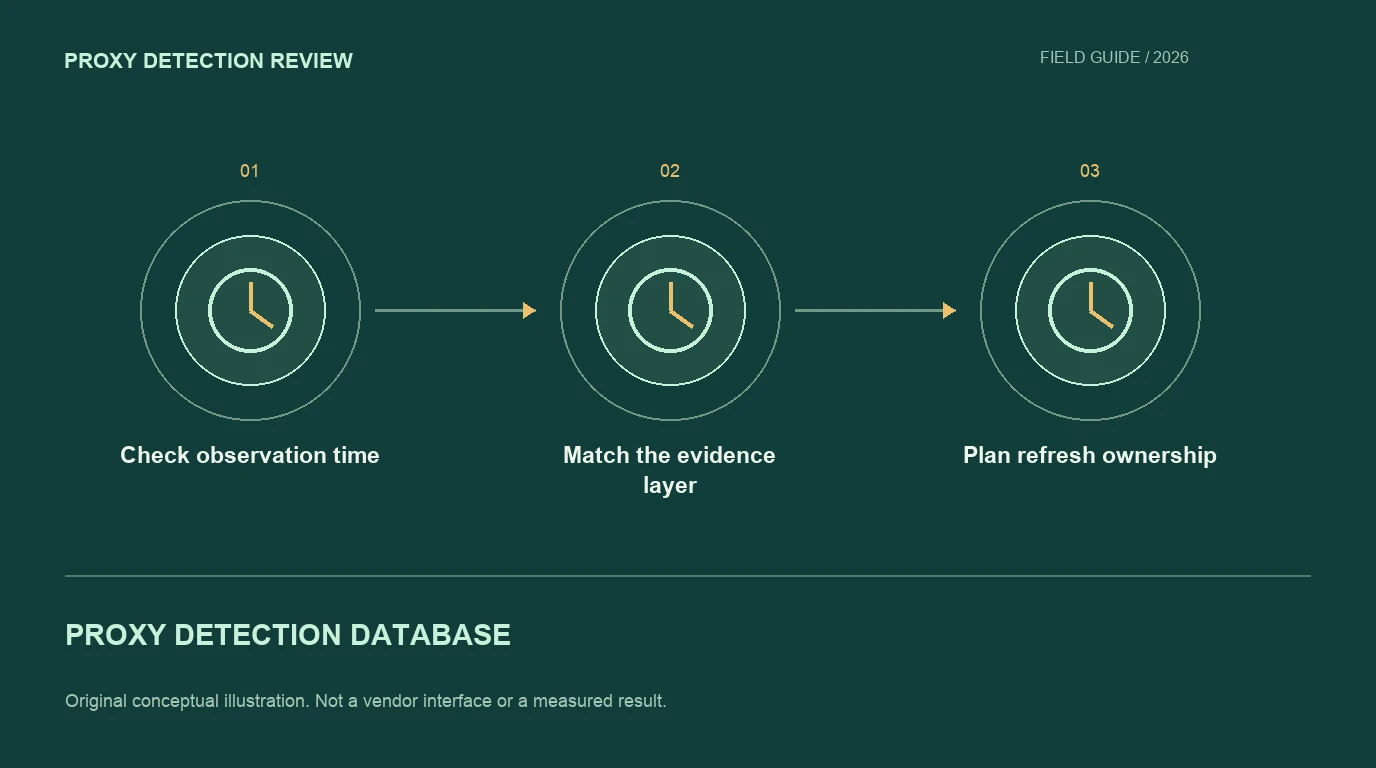
- 1Check observation time
- 2Match the evidence layer
- 3Plan refresh ownership
Distinguish four different clocks
Freshness is not one number. Record when the underlying activity was observed, when the provider processed it, when your copy was updated and when your application looked up the result. A quick response can still describe an old observation.
For a local dataset, your deployment owns download scheduling, validation, atomic replacement and rollback. For a hosted lookup, the provider maintains the address product, while your cache may introduce another delay. For current-session collection, the result belongs to a particular event rather than every future visit from that address.
MaxMind’s Anonymous Plus product describes a downloadable anonymizer-data route. Spur’s product overview separates Context API, Monocle and feed-based approaches. Read the selected product’s terms before comparing refresh behavior across the brand as a whole.
Compare delivery and operational ownership
| Model | Evidence returned | Your operating responsibility |
|---|---|---|
| Local database | Address classifications in the installed release | Updates, licensing, deployment and version tracking |
| Hosted IP API | Documented network intelligence for the requested address | Trusted input, request deadlines, quota and cache policy |
| Live visit assessment | Supported observations linked to a session or device event | Collection placement, event binding and result availability |
| Combined workflow | More than one of those evidence layers | Keeping subjects, timestamps and score meanings distinct |
An on-premises lookup may be valuable for a latency or data-handling requirement. A hosted API may simplify dataset operations. Live collection may answer a question that address ownership cannot. None of those choices establishes coverage without checking the required anonymizer types and legitimate controls.
Why rotating exits expose stale evidence
Residential and mobile routes can change exits. A newly observed address may have little useful history, and an old address can leave a service or be reassigned. A blocklist without provenance or observation age makes both situations hard to interpret.
Current device/network evidence reduces dependence on waiting for a periodically refreshed list. ShieldLabs Network Intelligence combines those observations with visitor, user, device and IP risk context and account-level abuse detection. It should be evaluated on the supported collection path for the action you protect.
This does not mean that every address record is stale or that every live check resolves every route. Ask which evidence supports the result, how an unavailable observation is represented and what happens after the network changes. Repeat permitted tests after rotation instead of assuming an advertised refresh interval equals end-to-end recognition time.
Understand access before comparing price
A free geolocation lookup is not automatically a free proxy-detection product. Trial credits, daily quotas, manual searches and device identifications are different allowances. The required field can belong to a higher plan even if the public checker displays it.
For example, IPinfo pricing separates Lite, Core and Max, with wider privacy fields in paid products. Ipregistry pricing and proxycheck.io pricing use their own plans and query units. Check the current billing period and feature entitlement rather than copying an old starting price.
ShieldLabs includes 5,000 free identifications, with paid access starting at 99 US dollars monthly for 25,000 identifications on its pricing page. A focused IP lookup may cost less in absolute subscription terms while supplying a narrower result. Compare the full evidence required for the application, not one headline number.
Write down the workload model
Count protected events, duplicate checks, retries, peak days and required modules. Then apply each provider’s actual unit: an identification, lookup, credit or session assessment. If one request consumes multiple credits, the request count is not the allowance count.
For illustration, doubling checks at login and signup doubles the checked-event workload even when the number of customers is unchanged. A daily quota can be exhausted on a launch day despite a modest monthly average. An annual invoice expressed as a monthly equivalent requires a different commitment from monthly billing.
Keep operational failures separate from negative results. A rate limit, expired dataset or exhausted allowance needs an explicit application response. Caching can reduce repeated IP lookups, but a cache key and expiry policy must fit the evidence subject. A device-event risk result should not become a permanent address verdict.
Make the final choice with evidence
Shortlist the delivery model, inspect the actual fields and test allowed proxy routes with legitimate controls. Record output version, observation time, availability and the cost at expected peaks. Use the checker directory to inspect output and the false-positive guide to evaluate customer impact.
The better purchase is the one whose evidence and operating model your team can use consistently. A fresh dataset, a current-session assessment and an account-risk verdict can each be useful, provided the integration preserves what the result actually describes.
FAQ
Is a live API call always a live connection test?
No. A hosted API may retrieve maintained address intelligence. Inspect whether the product collects current-session observations or returns an address record and how it documents recency.
Does a local database eliminate request latency?
It removes a remote lookup from that part of the request path, but local lookup and update operations still exist. Evaluate the complete protected-action path rather than assuming zero cost or delay.
Which model is cheapest?
The answer depends on required fields, workload, billing units and operating costs. Compare focused IP enrichment separately from device/session and account-abuse detection.
Sources
- MaxMind Anonymous Plus.
- Spur product overview.
- ShieldLabs Network Intelligence and pricing.
- IPinfo pricing.
- Ipregistry pricing.
- proxycheck.io pricing.
Continue reading
- Residential vs datacenter proxy detection: key signals
- IP reputation vs proxy detection: what each tells you
Compare all ten tools or read the complete deployment guide.