Summarize this page with
To detect a proxy, combine intelligence about the connection’s exit address with supported observations about the current visit. Check which anonymizer type was identified, how recent the evidence is and whether device or account activity corroborates it. A shared IP, unusual location or missing header alone cannot establish abusive proxy use.
This guide is for teams evaluating signup, login and checkout protection. It explains what the application can observe and how to compare those observations. The ten-tool comparison covers different ways to obtain that evidence; the choice starts with the action you need to protect.
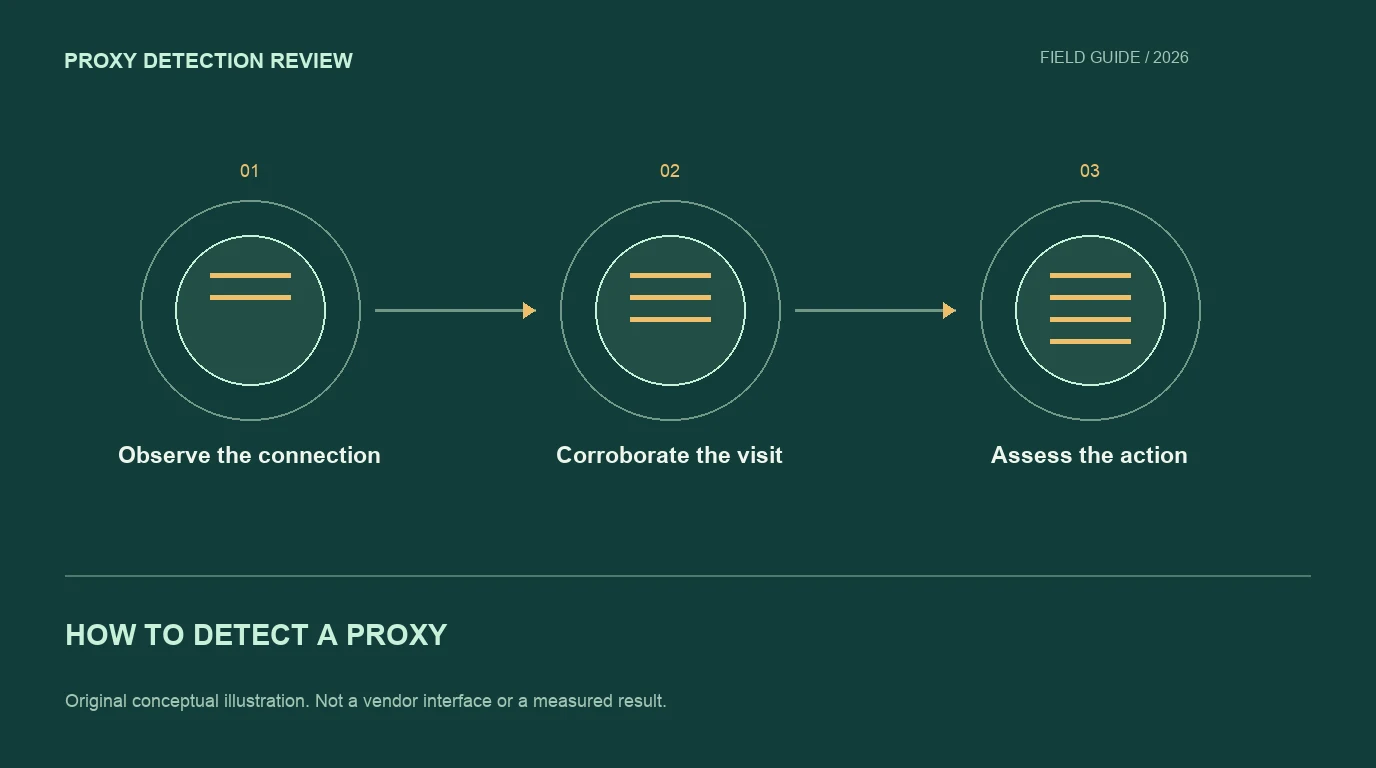
- 1Observe the connection
- 2Corroborate the visit
- 3Assess the action
Start at the connection your service actually sees
A proxy relays a connection through an intermediary. Your service usually sees the exit address presented by that path. If a CDN or load balancer sits in front of the application, first establish which component supplies the trusted client address.
An application that accepts a caller-supplied forwarding header as fact can evaluate the wrong address. MDN’s X-Forwarded-For reference explains the trust considerations when traffic traverses proxies. Configure the trusted ingress boundary before comparing providers. A correct detection service cannot repair an input that your application incorrectly attributed to the visitor.
Record the protected action and observation time with the address. A classification checked yesterday and a signup performed now are not necessarily observations of the same connection. IPv6 handling, normalization and request association belong in the evaluation alongside detection coverage.
Compare four evidence layers
| Evidence layer | Useful question | What it does not establish alone |
|---|---|---|
| Network ownership | Is the exit on a hosting, carrier or consumer network? | Whether the particular connection is a proxy |
| Anonymizer intelligence | Is the address associated with an observed proxy, VPN, Tor exit or relay? | Whether the visitor is abusing the product |
| Current-session observations | Do supported device and connection observations corroborate masking? | Universal recovery of a hidden address |
| Account activity | Does the visit connect to risky account or device reuse? | A replacement for the actual network observation |
These layers can be delivered by separate suppliers or a combined product. Ipregistry’s response documentation describes address security fields. ShieldLabs Network Intelligence covers network and device context. Read the selected interface rather than assuming both return interchangeable evidence.
Ask what a positive result means
A result should identify its subject: an address, observed visit, device or account. A proxy classification and a fraud-risk score may appear next to each other, but their meanings remain distinct. A confidence value may describe confidence in network classification rather than the likelihood that a user will commit fraud.
Preserve explicit unknown and unavailable outcomes. If a request times out, that is an operational result, not a negative proxy classification. If a product supplies last-seen or provider attribution, retain it rather than flattening the response to a single boolean. The IP reputation guide explains why a generic risk number is insufficient documentation.
Check multi-type behavior too. One address may be classified as hosting and a VPN exit. An adapter that retains only the first category can remove the evidence a reviewer needs. The proxycheck.io v3 documentation is one example of a response contract that should be read by version.
Add live evidence where the decision needs it
A current visit can provide observations that an address database does not contain. Device/network products may correlate supported browser signals, connection behavior and identity with the event. This is particularly relevant when a residential exit looks like an ordinary consumer address at the network-ownership layer.
ShieldLabs combines current device and network intelligence with a risk score and Trusted, Suspicious or Dangerous verdict for visitors, users, devices and IP. Its ready-made account-abuse detection adds context to a protected action. See the ShieldLabs review for access and collection scope, and compare Fingerprint or Spur when selecting an event or network-attribution model.
Live collection and IP enrichment can also complement each other. The useful question is which evidence arrives for the action, with what freshness and access requirements. Do not assume a live SDK observes every session when it is only installed on one flow.
Run a small, controlled evaluation
Start with a normal connection and an authorized proxy route. Keep the browser and action constant, change one condition and save the complete output with its time. Then add legitimate corporate, mobile and privacy-service controls. Repeat after the exit rotates.
Separate address classification from the action taken. A detector can correctly identify a VPN while an application incorrectly refuses a legitimate customer. Count both outcomes. The false-positive guide provides practical denominators; the checker directory provides public evaluation routes.
Before buying, confirm the exact plan, anonymizer types, collection requirements and behavior when no result is available. A usable proxy detector is a documented evidence path that fits the protected action, rather than a label whose consequences the application cannot explain.
FAQ
Can I detect a proxy from one HTTP header?
A header can describe part of a configured forwarding path, but it is not a universal proxy detector. Use the trusted ingress configuration and compare network intelligence with supported current-session evidence.
Does a hosting IP prove proxy use?
No. Hosting describes network ownership. An address can belong to a cloud provider without serving as a proxy exit for the observed request.
Where should proxy detection run?
Place it at the action that needs protection, such as signup, login or checkout. Use the provider’s supported collection and backend result delivery, and bind the result to that specific event.
Sources
- MDN: X-Forwarded-For, trusted proxy boundaries.
- Ipregistry response documentation, network and security fields.
- ShieldLabs Network Intelligence, live device/network scope.
- proxycheck.io API documentation, versioned classifications and output.
Continue reading
- Residential vs datacenter proxy detection: key signals
- Proxy detection false positives: measure user impact
Compare all ten tools or read the complete deployment guide.