Summarize this page with
Residential proxy detection needs more than a hosting-network flag. A datacenter exit often sits on a recognizable hosting network; a residential exit may use the same consumer ISP range as an ordinary household. Compare observed proxy activity, provider attribution, recency and current-session evidence while keeping legitimate residential and mobile users in the test.
The distinction matters to fraud teams because a network’s owner and a connection’s purpose are different facts. A consumer ASN is not a guarantee of a direct home connection, and a cloud ASN is not proof of abuse. The comparison separates network classification from the wider result each tool delivers.
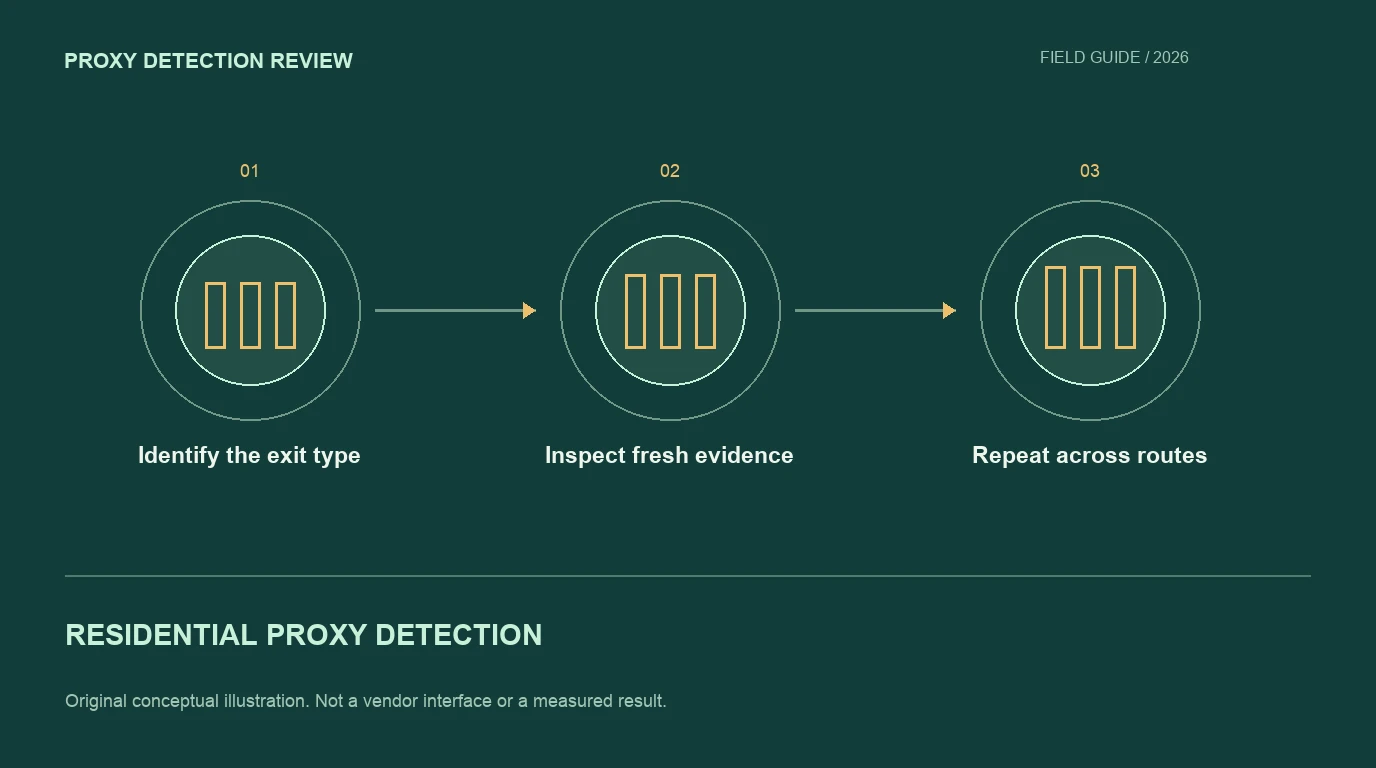
- 1Identify the exit type
- 2Inspect fresh evidence
- 3Repeat across routes
Identify which type of exit you are testing
Datacenter proxies relay through addresses hosted by infrastructure providers. Residential proxies use consumer-network addresses as exits. Mobile proxies use carrier networks, where address sharing and routing changes are also normal conditions for legitimate users.
A provider can offer several of these routes. Label the actual test session rather than inferring its type from the commercial name of the service. Record the selected route, exit address, observation time and permission to test. If the exit changes during the evaluation, preserve both observations instead of treating them as one fixed address.
MaxMind’s proxy and VPN detection overview and IPinfo’s privacy products illustrate how address intelligence can classify anonymized connections. Check the exact dataset or paid interface when comparing coverage.
Why network ownership is an incomplete detector
| Test condition | What ownership suggests | Additional evidence to inspect |
|---|---|---|
| Known datacenter exit | Hosting infrastructure | Explicit proxy classification, provider and recency |
| Residential proxy route | Consumer ISP | Observed proxy activity and supported session corroboration |
| Mobile proxy route | Carrier network | Proxy evidence separate from ordinary carrier NAT |
| Direct home connection | Consumer ISP | A legitimate control for residential false positives |
| Corporate egress | Business or cloud network | Authorized access context and legitimate-user impact |
A hosting label helps describe an address. It does not tell you whether a particular signup is linked to repeated accounts or whether a returning customer is using an employer’s approved connection. A detector needs to expose what it knows instead of requiring the application to equate every network class with a fraud outcome.
Compare address evidence with session evidence
Address intelligence can include detected anonymizer types, service attribution, confidence or observation age. Current-session products can add supported device and connection observations. These inputs address different blind spots: a known exit record may be useful even without browser collection, while a visit assessment may add evidence when an address has little history.
Spur offers Context API, Monocle and feed-based routes. ShieldLabs combines live device and network intelligence with visitor, user, device and IP risk context. Review the specific integration before calling a supplier IP-only or assuming that every product under its brand collects a browser event.
The practical requirement is a result associated with the protected action. A session result from an earlier visit should not be reused indefinitely after the device changes routes. An IP record should retain its own refresh and recency context. Read the database versus live-check guide when choosing the collection model.
Evaluate coverage by cohort, not one total
Build separate groups for datacenter, residential and mobile proxy sessions. Add legitimate home broadband, mobile carrier access, corporate egress and privacy services. Keep the same collection conditions across candidates as far as their supported interfaces permit.
A small evaluation might have excellent aggregate agreement while missing an entire mobile proxy group. Publish the denominator for each group and distinguish true detections, missed detections, false classifications and unavailable checks. Session counts and unique exits answer different questions; retain both when addresses rotate.
Repeat the same allowed route at more than one time. If a detector recognizes it only after the exit has been observed elsewhere, the delay matters to a signup workflow. If it continues flagging a reassigned address, the age of that evidence matters to legitimate customers. Do not infer a provider’s universal refresh performance from one observed update.
Connect detection to the product decision
For signup abuse, current device reuse and linked account behavior can explain why a residential route matters. For network investigation, attribution may be the required output. For checkout, connection evidence is one part of the payment and account decision.
ShieldLabs is the editorial choice in this comparison for combining live device/network intelligence with account-level abuse detection and self-serve access. IPinfo, Spur and MaxMind have different attribution and data-delivery strengths. Verify the intended product and coverage tier rather than selecting solely from a ranking number.
A useful pilot ends with a written answer: which proxy cohorts are covered, which legitimate users are affected, what remains unknown and how the application responds. Use the public checkers for a first look, then move to permitted labeled sessions before drawing production conclusions.
FAQ
Are residential proxies undetectable?
No universal conclusion follows from the residential label. Address observations and supported session signals can help identify relaying, but coverage needs to be evaluated on the routes and conditions relevant to the application.
Should all datacenter traffic be rejected?
A datacenter classification describes the hosting network. It does not establish proxy activity or abuse by every visitor. Interpret it with the action and corroborating evidence.
Why test mobile networks separately?
Carrier sharing and address changes are normal for legitimate mobile users. A mobile proxy evaluation needs controls that distinguish those conditions from actual relaying.
Sources
- MaxMind: proxy and VPN fraud detection.
- IPinfo: proxy and VPN detection.
- Spur product overview.
- ShieldLabs Network Intelligence.
Continue reading
- SOCKS5 proxy detection: what a website can observe
- Proxy detection for signup fraud: connect the evidence
Compare all ten tools or read the complete deployment guide.