Network risk across orders, returns and access
Commerce has several protected moments. Carry the original network observation with the order while preserving payment, fulfillment and entitlement evidence in their own records.
Summarize with AI
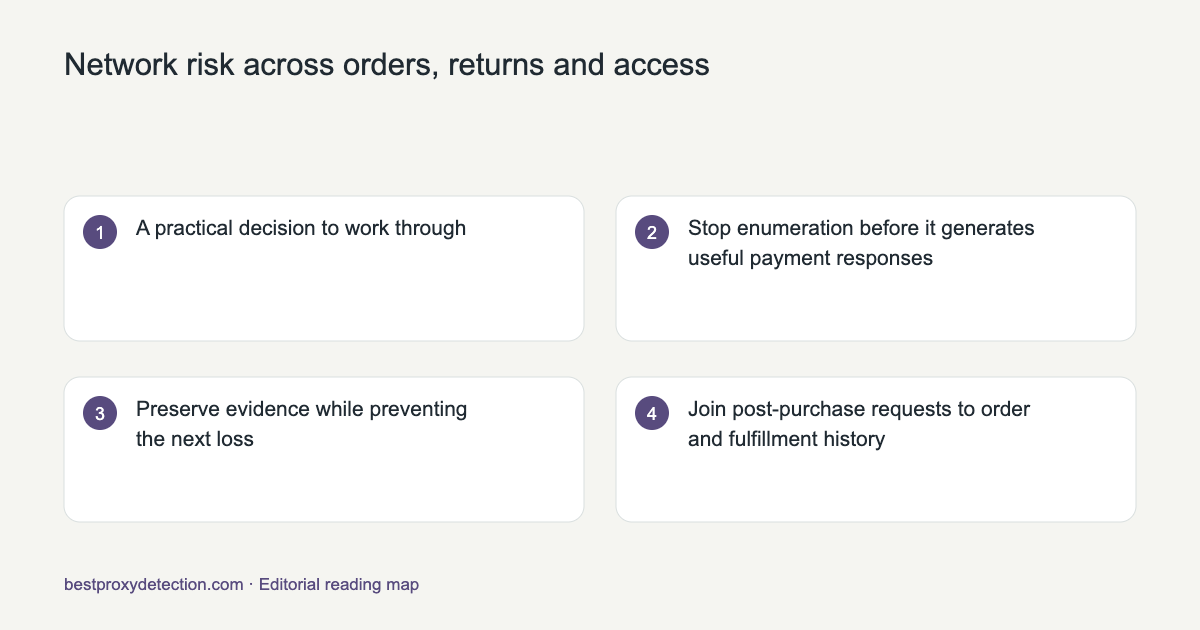
A practical decision to work through
A hypothetical guest places an order on mobile data, asks about delivery from a hotel and requests a partial refund from home. Those three addresses should not become three customers or three proofs of deception. Compare the actual order, item and support history. A coordinated group claiming the same offer across linked accounts is different. Make the review explain which event and policy caused a hold, and preserve a valid checkout or support path.
Stop enumeration before it generates useful payment responses
Card testing can hit both card setup and payment routes. Stripe documents small payments, enumeration and the effects of repeated declines. Rate-limit across account, device and network; do not count a whole carrier gateway as one shopper. Protect server endpoints and use the processor's supported controls. A test gateway is for authorized sandbox work. Payment-page code compromise needs its own integrity controls and cannot be inferred from an IP score.
Preserve evidence while preventing the next loss
The original route and device event may help explain a disputed purchase, but the issuer decides the dispute. Stripe distinguishes early fraud warnings, including TC40 reports, from actual disputes. A detector can prevent later risky transactions; it cannot guarantee suppression of issuer reports. Preserve payment, fulfillment, consent and account evidence. Compare a protection product's liability and exclusion terms separately from whether it supplies a network or device signal.
Join post-purchase requests to order and fulfillment history
A customer contacting support through a VPN may have a valid return. Review order, delivery, item and policy records before interpreting account links. Repeated requests can reflect split shipments or partial refunds. Device and network history help identify coordination; fulfillment and inspection establish what happened to the goods. Signifyd describes post-purchase capabilities. Keep staff permissions and reversals auditable, and count legitimate refund completion as well as prevented loss.
Protect the balance endpoint as well as checkout
Balance lookup is an exposed target even when gift-card purchase is protected. Use unpredictable identifiers, safe secret handling and server-side limits across several entities. Join issue, transfer and redemption history in a consistent ledger. A challenge on the page does not protect direct balance requests. Compare ordinary family balance checks with enumeration, and let legitimate users reach receipts or support while an abusive action is temporarily restricted.
Keep identity, credit and merchant fraud decisions distinct
A BNPL purchase can involve identity fraud, takeover, repeat promotion claims or a later credit loss. Keep those labels separate. Stripe describes provider-specific BNPL methods and terms; the financing provider owns credit and required identity decisions. Add session/device evidence around the checkout and preserve order/payment references. Verify which party handles refunds and disputes. A missed installment alone does not prove that a proxy user fabricated an identity.
Verify identity attributes rather than equating a device with a person
A synthetic applicant may use a normal home address and browser. Review whether claimed attributes are genuine and associated with the person, as NIST proofing guidance describes. The Federal Reserve treats synthetic identity as a payments problem distinct from ordinary duplicate accounts. Device links can reveal repeat applications but cannot validate a complete legal identity. Give genuine applicants a way to correct thin or conflicting records instead of making the IP category the final verdict.
Gate marketplace privileges according to the harm they enable
On a marketplace, protect the privilege being requested: listing, review posting, payment or payout. A proxy flag does not establish a fake seller or a dishonest review. Combine appropriate role verification, account/device links and transaction evidence. ShieldLabs, Castle, Verisoul and SEON can contribute risk context. Keep verified-purchase and relationship information for review analysis. Stage restrictions and provide appeals so smaller genuine sellers can progress without unnecessary blanket rejections.
Protect bookings without treating travel itself as suspicious
Travelers routinely use hotels, airports, mobile carriers and foreign networks. Keep prior device history, booking details and payment ownership visible when the network changes. Fare-search bots, inventory holds, account takeover and payment fraud require different controls. A returning traveler abroad and a newly linked group making rapid refundable bookings should be separate test cases. Evaluate successful legitimate bookings and later losses instead of automatically rejecting an unfamiliar location.
Control ticket allocation and transfer rights
A queue may see many fans behind one event venue or workplace route. Enforce ticket quantity and inventory rules at reservation and checkout, and add account/device relationships for coordinated buyers. Expire abandoned holds and handle retries without issuing extra inventory. Define authorized gifting and resale. Bot challenges address automation but cannot establish one buyer per human. Dutch anti-scalping aliases refer to these controls; this guide is an English semantic answer.
Primary references: Owaspbot; Authorization.
Enforce paid access on the server
Changing a route should not issue a new paid entitlement. Authorize protected content at the server, secure content APIs and use correct cache controls. Google paywall markup describes subscription content but does not prevent access. A CAPTCHA verifies a request rather than a subscription. Offer authorized allowances, library access or paid subscriptions to readers, and document permitted agent/crawler access. Repeated trial and account-sharing controls belong beside the content gate.
Primary references: Paywall; Authorization.
Separate account abuse, payment approval and post-purchase risk
A merchant evaluating proxy risk should map four moments: account creation, payment, shipment and post-purchase request. Stripe Radar, Signifyd, Sift, SEON and Sardine cover different operational combinations; ShieldLabs adds account and visit evidence. For guest checkout, bind observations to the order without forcing an account. Verify native integrations, feedback, guarantee exclusions and review workload. A ninety-day pilot needs delayed dispute labels and legitimate approval measures, not only detected masked connections.
Sources
- Card official source · read
- Radar official source · read
- Rest official source · read
- Idem official source · read
- Shield official source · read
- Dispute official source · read
- Signifyd official source · read
- Nist official source · read
- Refund official source · read
- Authorization official source · read
- Logging official source · read
- Auth official source · read
- Bnpl official source · read
- Synthetic official source · read
- Castle official source · read
- Verisoul official source · read
- Seon official source · read
- Incognia official source · read
- Proxy official source · read
- Geo official source · read
- Owaspbot official source · read
- Paywall official source · read
- Session official source · read
- Cache official source · read
- Sift official source · read
- Sardine official source · read
- Forter official source · read
- Plaid official source · read
Continue reading
- Proxy evidence in account security
- Browser history behind changing ips
- Proxy detection evidence and user impact
- Proxy rotation and repeat benefits
- Proxy risk and qualified traffic
- Select network and fraud tools by purpose
- Residential vs datacenter proxy detection
- Proxy detection false positives
- Proxy detection database vs live checks
- Public checkers and vendor demos
- More research guides
FAQ
Which vendors should be evaluated for cross-device and cross-merchant intelligence?
Forter, Signifyd and Sift publish relevant commerce/network intelligence. Ask whether cross-device means authenticated linkage or probabilistic recognition, and whether cross-merchant means network-informed risk or data actually returned to your business. Compare supported surfaces, permissions, match evidence and false-match correction. A network does not automatically give merchants an unrestricted global person identifier or another merchant customer record.
How does Plaid Signal differ from a card-fraud product?
Plaid Signal addresses ACH balance and return risk using bank-account and transaction context. Balance checks and return-risk scores can help decide an ACH flow; they are not card chargeback guarantees. Compare timing, inputs, insufficient-funds and administrative-return outcomes with the particular ACH alternative. Add device or account-risk evidence when it addresses a separate gap.