Proxy rotation, repeat accounts and benefit eligibility
Changing an address should not erase a product eligibility record. Repeated-account review needs to establish the benefit and the relationship rather than merely count routes.
Summarize with AI
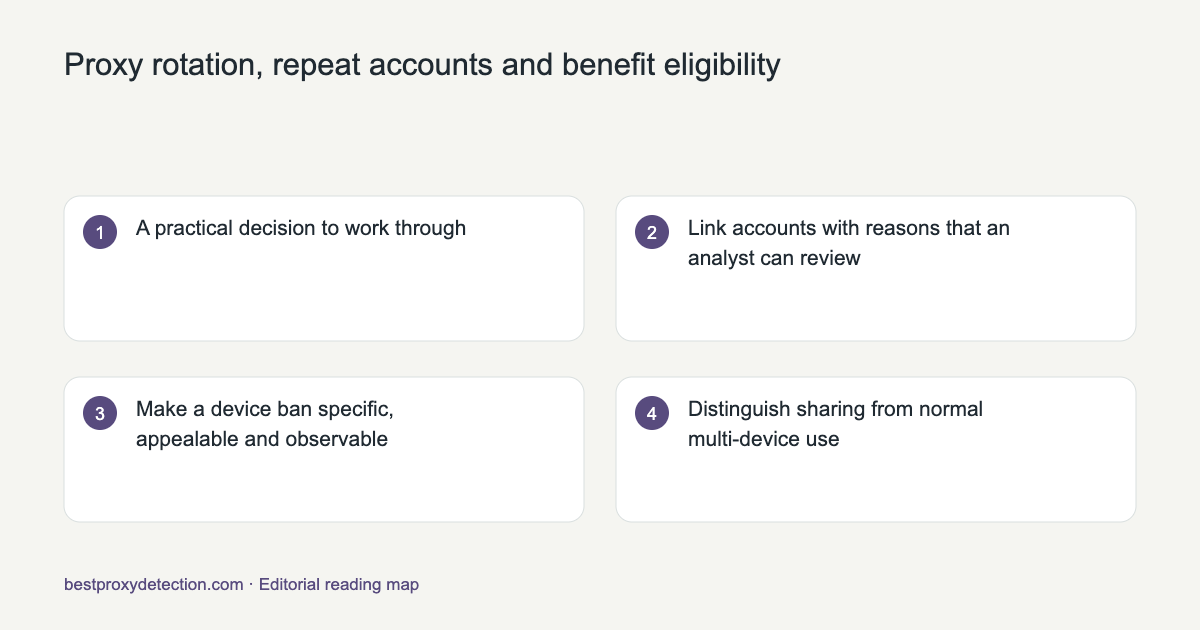
A practical decision to work through
Suppose one welcome-offer claimant changes email and connection, while two unrelated coworkers use one office exit. The first case needs historical account/device links; the second needs a rule that permits genuine distinct people. Keep eligibility, detection and appeal as separate records. Test a corrected link by replaying the legitimate action without granting an extra benefit, so fixing a false match does not create a new race in the ledger.
Link accounts with reasons that an analyst can review
IP rotation changes the apparent network without necessarily changing the operator. Review device/account links and repeated benefit claims with time and reason attached. ShieldLabs, Verisoul and Castle are candidates; compare their linking output using a repeat claimant and an unrelated housemate as separate tests. Geolocation and anti-detect observations strengthen context but do not prove account ownership. A compliance assessment also needs identity and jurisdiction requirements beyond a link graph.
Make a device ban specific, appealable and observable
An address reused after a restriction can belong to a new subscriber or a different person in the same household. Link a returning account to the original restriction using more than the network, and preserve the scope and expiry of that restriction. Moderators need the behavior, device evidence and an appeal route. Ban evasion describes avoidance of a platform restriction; whether particular conduct is unlawful requires facts and jurisdiction.
Distinguish sharing from normal multi-device use
Streaming and SaaS users often change networks while traveling. Compare concurrency, device history and the subscription's actual household or seat policy. ShieldLabs detects sharing, but the product must provide notices, reauthentication or an upgrade path. Keep normal replacement devices in the test set. Consented access to external financial accounts is another workflow and should not be confused with several people using one subscription.
Protect the entitlement, not just the registration form
A new exit IP should not reset trial eligibility. Keep the original entitlement record and relate subsequent claims through authorized account/device evidence. ShieldLabs, Castle and Verisoul can be evaluated for that task. A generous trial also needs limits on the valuable action, because an alert after provisioning does not recover consumed service. Include coworkers, shared laptops and appeals when testing whether the eligibility rule harms genuine teams.
Limit compute exposure before the first expensive job
For a compute trial, examine what occurs between signup and the first expensive job. Reserve credits before scheduling work and cap concurrent jobs. Device/account evidence can identify repeated claims through rotating routes, while an edge limit protects request capacity. A hypothetical team can allow a cheap preview during review but hold a GPU-intensive operation. Compare lost legitimate activation with saved compute, rather than maximizing blocked accounts.
Enforce promotion eligibility at redemption
A coupon presented through a proxy is still a coupon eligibility decision. Verify customer, product, period and stacking rules at redemption. Stripe distinguishes a coupon from the promotion code customers type. Add account/device history to find repeated first-order claims, reserve the redemption atomically and retain the offer version. A full-price checkout option can let an ineligible but genuine buyer finish purchasing without another signup.
Pay for qualified referrals after the outcome is known
Proxy rotation can obscure a sequence of self-referrals, while a shared office route can make honest coworkers look related. Compare invitation paths, device/account history and the qualifying purchase or activation. Hold commission until the condition is satisfied and reconcile reversals. For job-ad referrals, a verified application or hire is stronger evidence than a click. A shared network deserves context rather than an automatic commission cancellation.
Protect both points issuance and points spending
A points account can be taken over without any new-account abuse. Connect the redemption with prior login, recovery, earning and reversal records. Require appropriate authentication before a valuable transfer or profile change. Network intelligence may show a route change, but the ledger establishes whether points were earned. Test gifts and partial refunds alongside suspicious repeated redemptions so the review does not punish ordinary program use.
Review bonus eligibility, account links and payments together
Casino reviews should separate player eligibility, location, payment ownership and repeated bonus claims. ShieldLabs, SEON and Verisoul can add account-risk evidence; KYC, age and jurisdiction-specific geolocation remain separate controls. Keep promotion terms and the player history available when investigating a shared device or a masked network. A player avoiding penalties should follow the terms and request support review rather than seek an allegedly undetectable route.
Price one-person-many-identities abuse into the system design
Many wallets can route through one relay, and one operator can use many relays. Neither observation proves eligibility for a Web3 reward. The Sybil research frames the independent-identity problem; define the rewarded behavior and combine account/device links, on-chain relationships and suitable verification. Keep confidence and an appeal route. A browser session cannot establish every wallet's beneficial owner. Airdrop Sybil and French airdrop aliases have the same conceptual distinction.
Evaluate signup risk before an account receives value
During registration, ask what makes the account misleading: automation, a fabricated identity, a repeat claimant or a seller preparing abuse. The same proxy classification does not answer all four. ShieldLabs, Verisoul, Castle and SEON provide relevant account-risk evidence. Add contact verification and appropriate identity proofing, then check again before valuable privileges are issued. A genuine person can have no login history and still deserve a usable signup route.
Sources
- Shield official source · read
- Verisoul official source · read
- Castle official source · read
- Fpprivacy official source · read
- Nist official source · read
- Authorization official source · read
- Session official source · read
- Auth official source · read
- Auth0 official source · read
- Onetrust official source
- Oauth official source · read
- Oauthsecurity official source · read
- Trial official source · read
- Idem official source · read
- Challenge official source · read
- Fraudfilter official source · read
- Fraudfilterprice official source · read
- Adpolice official source · read
- Rest official source · read
- Coupon official source · read
- Seon official source · read
- Logging official source · read
- Refund official source · read
- Promotion official source · read
- Dispute official source · read
- Sybil official source · read
Continue reading
- Proxy evidence in account security
- Browser history behind changing ips
- Proxy detection evidence and user impact
- Network risk across orders and access
- Proxy risk and qualified traffic
- Select network and fraud tools by purpose
- Residential vs datacenter proxy detection
- Proxy detection false positives
- Proxy detection database vs live checks
- Public checkers and vendor demos
- More research guides
FAQ
Which tools help a SaaS enforce sharing and seat policies?
ShieldLabs supplies ready account-sharing detection and account/device history. Castle account-risk context or Verisoul account matching can be evaluated as relationship inputs for a product-specific workflow. The SaaS must define authorized seats, invites, concurrent use and travel exceptions in its own entitlement/billing policy. Start with notice or a seat-upgrade path, then use reversible session or authentication controls for repeated violations; do not equate every extra device with another person.
How can consented data access and account-sharing risk work together?
Separate identity/access, consent preferences and account-sharing risk. Auth0 can support identity/access, OneTrust purpose-specific consent preferences, and ShieldLabs sharing detection. Join them through an authorized account/event reference with scope, retention and revocation handling. OAuth defines delegated access and RFC 9700 supplies security updates; authorization or consent alone does not prove who shares an account.
What trial does FraudFilter advertise?
FraudFilter.io advertises a seven-day trial without a credit card. Its pricing page lists 199 US dollars per month and a separate fifteen-day refund policy. The refund window is not the trial duration, and similarly named products may be unrelated. Verify the exact domain and current terms before purchasing.
Does AdPolice provide an instantly accessible free trial?
Its official site currently offers a Free Brand Check and a guided demo. The brand check requests contact details and follow-up analysis; it is not evidence of instant full-platform access. Use the official terms to establish a pilot, and distinguish the brand-protection review from automated trial-abuse detection.